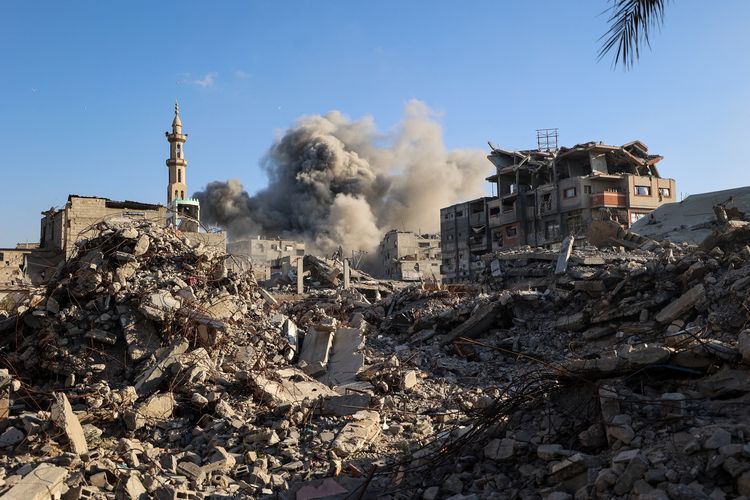
Israeli missiles once again split the skies over Gaza, as if the heavens had never truly known the meaning of pause. The strikes occurred even amid claims of a ceasefire.
At the same time, Israel’s control in the West Bank expanded. The world voiced strong protests. Yet the Gaza Board of Peace (BoP) — established by U.S. President Donald Trump, with Indonesia as one of its members — has shown little sign of assertiveness.
Despite a ceasefire agreement reportedly in place since October 2025, the February 9, 2026 explosion in Gaza City tore apart not only buildings sheltering refugees, but also the very meaning of the word “peace.”
Civilians once again became mere statistics in reports, while the map of agreements — intended to mark safe boundaries — proved to be nothing more than fragile lines on paper.
Here lies a classic paradox: commitment without oversight and enforcement mechanisms is merely an illusion of stability. Without clear deterrence instruments, a ceasefire becomes a tactical pause rather than a bridge toward sustainable conflict resolution.
The incident also signals the erosion of international normative authority. International law is built upon the assumption that violations are followed by consequences, that moral legitimacy carries weight equal to military power.
Yet when formal agreements can be violated without firm response, norms risk being reduced to symbols — respected in speeches, ignored in practice.
The world thus moves toward increasingly transactional relations, where strategic alliances and military superiority weigh more heavily than global ethics.
In an emerging yet unsettled multipolar configuration, Gaza reflects how fragile a world order based solely on a balance of interests can be.
At the regional level in the Middle East, missile explosions never remain confined to a single coordinate. They ripple outward as psychological and political waves.
Every escalation in Gaza carries spillover effects: polarization of public opinion, domestic pressure on Arab governments, and the potential for radicalization rooted in collective disappointment.
Countries striving to stabilize their economies and recalibrate diplomatic relations face a dilemma between pragmatic calculation and demands for solidarity.
Regional stability, from a security perspective, is not merely about military balance, but also about political legitimacy in the eyes of the people.
The “Board of Peace” Must Become a Reality of Power
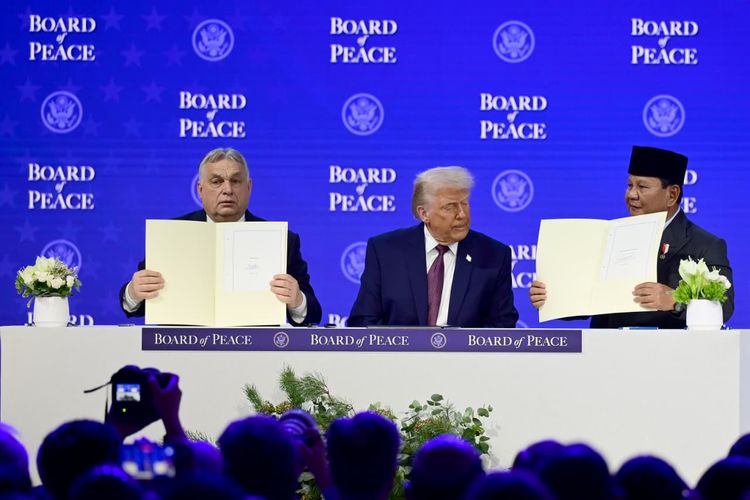
The Board of Peace was born with a promise that sounded noble: to create pauses between explosions and place diplomacy above the whizzing of bullets.
When U.S. President Donald Trump initiated it, and Indonesia became one of its members, many saw it as a breakthrough — an effort to escape the longstanding deadlock surrounding the conflict.
But time is the most honest test of any institution. As missiles continue to launch and civilian casualties mount, a question lingers: is the Board of Peace a bridge to peace, or merely a new stage for old rhetoric?
In global geopolitics, legitimacy is the primary currency. A peace institution is measured not only by the intentions of its founders, but by the world’s perception of its independence.
Because the Board of Peace originated from a United States initiative — a strategic ally of Israel — the shadow of major interests is not easily erased.
Without a clear investigative mandate and firm sanction mechanisms, it risks being perceived as an instrument of image diplomacy: present to demonstrate commitment, yet lacking the coercive power to alter realities.
In an increasingly multipolar world, perceptions of bias can erode moral authority more quickly than open criticism.
At the Middle Eastern regional level, the effectiveness of the Board of Peace serves as a barometer of trust in emerging multilateral architectures outside the United Nations framework.
If it operates transparently and impartially, it could become a model for more adaptive conflict governance.
If it fails, regional disappointment may lead to a resurgence of bloc politics and more confrontational collective security logic.
A region long marked by great power rivalries does not need additional symbols, but mechanisms genuinely capable of restraining escalation and restoring trust.
Thus, Indonesia’s involvement in the Board of Peace represents a crossroads between opportunity and risk.
An opportunity, because it opens space for direct participation in a process tied to global humanitarian concerns and the constitutional mandate to oppose colonialism.
A risk, because failure of the institution could tarnish Indonesia’s reputation as a country consistent in upholding international law principles.
Nevertheless, the “free and active” foreign policy demands the courage to engage without surrendering moral autonomy. It is not merely about presence in forums, but about influencing direction and substance.
Great Power Rivalry
The Israel–Palestine conflict has never been merely a dispute between two entities; it has always moved within the gravitational orbit of major world powers.
Around it, strategic interests revolve like unseen planets shaping trajectories.
The United States supports Israel not only due to historical alliance, but also because of Israel’s central role in Washington’s Middle Eastern security architecture and influence.
Meanwhile, Russia and China view the Palestinian issue as diplomatic space to expand their resonance in the Islamic world and the Global South.
In this context, Gaza is not merely a besieged territory, but an intersection of crossing global interests.
In a world moving toward multipolarity, the conflict has become a stage for narrative contestation.
The question arises: who truly defends international justice, and who merely cultivates image while calculating strategic gain?
That question echoes each time the UN Security Council stalls due to veto power, each time resolutions are halted by political calculation.
The legitimacy of the international system is tested: does it still serve as guardian of shared norms, or has it become an arena of power bargaining?
This global rivalry reverberates as a tangible dilemma. Middle Eastern states sit at a fragile equilibrium: maintaining relations with Washington, opening economic cooperation with Beijing, and considering security calculations with Moscow.
At the same time, domestic public opinion demands clear alignment with Palestine. Pressures from within and without render Gaza a strategic variable in regional security architecture.
Regional stability is no longer solely about military defense, but about managing political legitimacy amid global rivalry.
Within this vortex, Indonesia must practice its free and active policy with greater subtlety than mere rhetoric. Free means not being trapped in the orbit of one power; active means not remaining silent amid injustice.
Indonesia cannot sacrifice moral firmness for diplomatic comfort, yet it cannot ignore the reality that national interests encompass global stability, energy security, and cross-bloc economic relations.
Here, diplomacy is tested as the art of balancing principle and pragmatism.
Indonesia’s Role: From Moral Solidarity to Geopolitical Strategy
Indonesia does not arrive on the global stage empty-handed. It carries moral legitimacy as the world’s largest Muslim-majority country, a long history of peaceful diplomacy since the Bandung Conference, and a reputation as a bridge linking North and South, West and developing worlds.
This capital is not merely symbolic; it is the accumulation of history and consistency. Yet history holds value only if translated into action.
Moral legitimacy not embodied in concrete steps evaporates into rhetoric, while the world moves swiftly through calculations of interest.
In an increasingly multipolar global geopolitical context, Indonesia has space to play a more substantive role.
Violations of ceasefires and the weakening of international norms can be raised systematically in United Nations forums — not merely as statements, but through measured diplomatic initiatives.
At the regional level, particularly in the Middle East, Indonesia need not remain a distant spectator geographically close emotionally.
More intensive cooperation with the Organization of Islamic Cooperation (OIC) and key regional states could be directed toward establishing joint monitoring mechanisms for implementing peace agreements.
Such steps would strengthen solidarity while affirming Indonesia’s relevance as a strategic partner. In modern diplomacy, consistent presence carries more weight than loud voice.
This involvement must also be framed within national interests. Middle Eastern stability has direct implications for energy security and global economic stability.
Prolonged tensions may trigger oil and gas price volatility, disrupt supply chains, and pressure international financial markets — ultimately affecting Indonesia’s domestic economy.
In an interconnected world, distant conflicts can yield close consequences.
Thus, Indonesia’s active role is not merely an expression of ideological solidarity with Palestine or moral commitment to peace.
It is also a rational strategic calculation to safeguard global stability and long-term national interests.
Between idealism and realism, Indonesian diplomacy must find a productive convergence.
For ultimately, a nation’s strength is measured not only by its capacity to endure domestically, but by its wisdom in reading the world and acting at the right moment.
Geopolitical Peace and Indonesia’s Role
Peace must not be understood merely as the silence of gunfire. In geopolitical terms, peace is the art of structuring balance of interests through agreed norms and trusted institutions.
It is fragile yet valuable, built upon collective commitment to restraint.
When missiles are launched amid a ceasefire, what collapses is not only walls and roofs, but also the foundation of trust in the international system.
Law without enforcement is merely text, and agreement without accountability is a promise easily broken.
The world now stands at a historical crossroads: strengthen multilateralism or allow the international system to fragment under great power rivalry.
In an unstable multipolar configuration, every regional conflict risks becoming a testing ground for global influence.
Gaza thus becomes a symbol of that choice — whether the international community still believes in shared governance, or surrenders to bloc logic and veto politics.
When international forums are held hostage by strategic interests, global legitimacy is at stake and collective trust erodes.
Geopolitical peace demands more than cessation of fire. It requires balanced security guarantees and fair recognition of Palestinian political rights.
Without recognition of the right to self-determination and without inclusive security architecture, stability will remain temporary — calm on the surface, turbulent beneath.
For Indonesia, this moment must be read not merely as an external issue, but as a test of moral and strategic leadership.
The free and active policy must translate into proactive, consistent policies oriented toward long-term national interests.
Condemnation is a starting point, but insufficient. Indonesia is called upon to lead initiatives, build cross-regional coalitions, and ensure that its participation in various forums — including the Board of Peace — yields tangible and measurable impact.
International credibility is built not on rhetoric, but on consistency of action.
The world may continue to shift in currents of interest, but justice remains the anchor that keeps direction.
Indonesia, with its history of struggle and constitutional mandate, bears responsibility not merely to witness history, but to act as an advocate for geopolitical peace that is just, dignified, and sustainable.
Prof. Dr. Ermaya Suradinata, SH, MH, MS
Rector of IPDN (2015–2018), Director General of Social and Political Affairs – Ministry of Home Affairs (1999–2001), and Governor of Lemhannas RI (2001–2005).
 English
  Indonesian