Indonesia’s Geopolitics: The Free and Active Non-Aligned Movement in Upholding World Peace
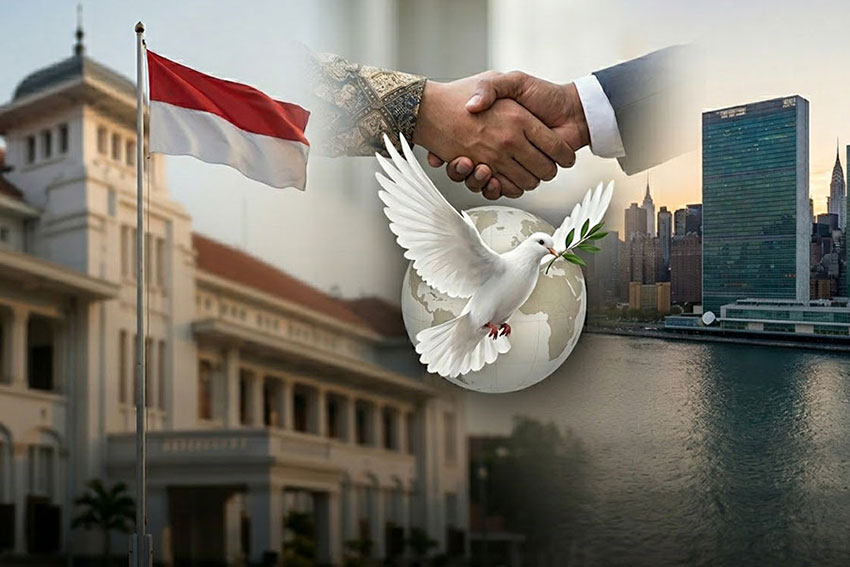
The history of Indonesia’s geopolitics is a long narrative of how a nation formulates its strategic position amid ever-changing global power dynamics. Since its early independence, Indonesia has not only sought to defend its sovereignty but has also asserted an active role in shaping a more just and peaceful world order.
Within this historical trajectory, Indonesia’s experience in the 1955 Asian-African Conference in Bandung, its involvement in the United Nations, its relations with the United States, and its participation in the Board of Peace (BoP) have become essential foundations for understanding the direction of Indonesia’s geopolitics—past, present, and future.
In the early years of independence, the world was gripped by Cold War tensions that divided global power into two major blocs. In such a situation, Indonesia faced a classic dilemma: align with one bloc or take an independent path. Indonesia’s decision not to take sides ideologically was not a passive neutrality, but a strategic choice rooted in the spirit of independence.
The 1955 Asian-African Conference in Bandung marked a significant milestone that affirmed this position. At this forum, Indonesia, together with Asian and African nations, built global solidarity that transcended narrow interests and rejected the dominance of major powers. The Bandung spirit was later articulated in various forms of international diplomacy, including Indonesia’s involvement in the Board of Peace (BoP).
Indonesia’s participation in the BoP was not merely a formal organizational involvement, but a concrete manifestation of its commitment to promoting world peace without being bound to the interests of any particular power bloc. Indonesia understands that peace cannot be achieved if the world remains trapped in the logic of rivalry and domination. By not aligning with any bloc, Indonesia gains legitimacy to act as a mediator and bridge between competing interests. In this context, the principle of a “free and active” foreign policy is not merely a slogan, but a strategy that enables Indonesia to remain relevant amid complex international dynamics.
Entering the contemporary era, the global geopolitical landscape has undergone significant transformation. Today, the world stands at the crossroads of interlinked crises. The war between Russia and Ukraine continues to disrupt global energy and food stability, highlighting the fragility of global resilience in the face of armed conflict. In the Middle East, escalating tensions between Iran and the Israel–United States axis heighten the risk of broader conflict, particularly as the region serves as a central hub for global energy distribution. Any spark of conflict in this area is not merely a regional issue, but a systemic threat that can destabilize oil prices and the global economy.
Similar tensions are spreading across other regions, creating a global landscape filled with uncertainty. In South Asia, security dynamics between Pakistan and Afghanistan continue to fuel conflict along their borders. In Southeast Asia, relations between Thailand and Cambodia have once again heated up due to unresolved territorial disputes. Meanwhile, in East Asia, rivalry between China and Japan is intensifying, marked by economic restrictions and strengthened security postures. This fragmentation indicates that the world is not only facing conflicts but also a deepening crisis of trust among nations.
Amid these tensions, the spirit of the 1955 Asian-African Conference regains its relevance. The values of Bandung—solidarity, equality, and independence—are not merely historical legacies, but moral foundations for a more just global order. Indonesia, as the birthplace of this spirit, carries a historical responsibility to revive it through a free and active diplomatic practice. In a world divided by competing interests and rivalries, the Bandung spirit must serve as a middle path: bridging differences, nurturing peace, and affirming that the independence of each nation only has meaning when accompanied by a collective commitment to global justice.
Looking ahead, Indonesia’s geopolitics will be largely determined by its ability to integrate past experiences with present needs. Its involvement in the BoP teaches that peace cannot be achieved through domination, but through dialogue and cooperation. Indonesia must leverage this position to become not only a reactive actor but also a proactive force in shaping a more equitable global order.
However, such geopolitical ambition must be supported by strong domestic foundations. Economic resilience, technological advancement, and the quality of human resources are key factors in determining Indonesia’s position on the global stage. Without a solid internal foundation, international roles risk becoming mere rhetoric without real impact. Therefore, national development must be viewed as an integral part of geopolitical strategy.
Ultimately, Indonesia’s geopolitics is about maintaining a balance between idealism and realism. From Bandung 1955, participation in the BoP, to relations with global powers such as the United States, Indonesia has consistently pursued a free and active path. This path is not merely a compromise, but a strategy that allows Indonesia to remain sovereign while contributing to the creation of world peace.
In a constantly changing world, this principle serves as a compass guiding Indonesia’s journey—a journey not only to endure, but to lead with dignity and integrity on the global stage, grounded in political stability and economic independence.
Prof. Dr. Drs. Ermaya Suradinata, SH, MH, MS
is an observer of geopolitics, geostrategy, and public administration.
 English
  Indonesian