Geopolitics and Geostrategy of Regional Leaders in Controlling Regional Inflation
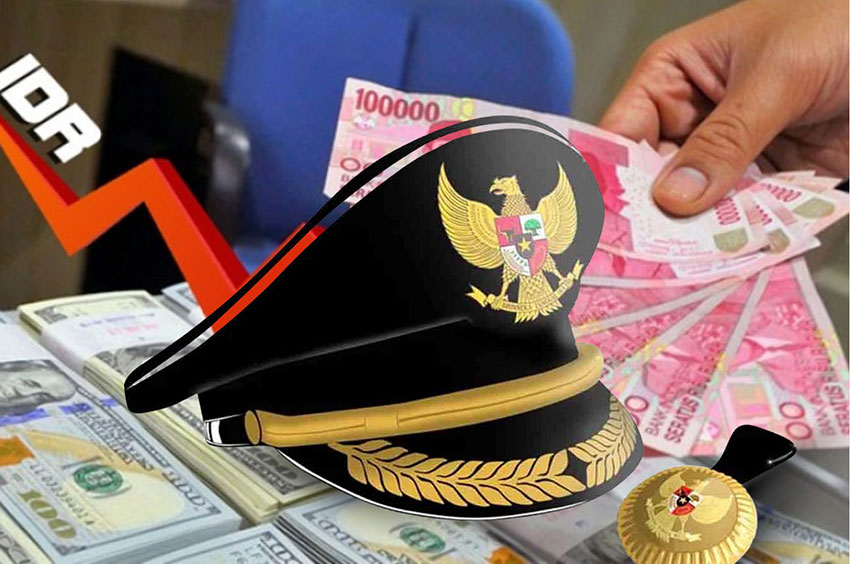
Within Indonesia’s landscape—woven like an archipelago across the equatorial belt—regional inflation is never merely an economic symptom to be handled through numerical calculations and statistical indicators. It resembles tidal currents that move through space, power, collective psychology, and intertwined social structures, driven by a far deeper geopolitical pull.
When regional leaders across Indonesia seek to control inflation, they are not simply operating fiscal instruments or supervising distribution. They are, in fact, recalibrating a fragile balance between people’s needs, the availability of economic space, and the direction of history that constantly shifts. From this perspective, inflation becomes a mirror reflecting whether a region can articulate Pancasila as a living vision, and whether Asta Cita truly pulses within development policies that are inclusive and equitable.
The geopolitics of regional inflation emerges from the reality that prices are not a single phenomenon; they are the outcome of encounters among geography, infrastructure, market power, and networks of authority. A province in eastern Indonesia, for example, tends to experience price fluctuations faster than regions on Java when the distribution of goods is disrupted by extreme weather or limited connectivity.
At that point, regional leaders are demanded to be not only administrators, but statesmen attuned to the articulation of space: they must be able to read how sea lanes, traditional markets, ports, food barns, and consumer behavior interact to form patterns that often remain unseen. Price politics, in a geopolitical sense, is the art of understanding how space shapes welfare. It is not an exaggeration to say that price stability in a region is a direct reflection of a leader’s competence in managing the interaction between the living space of society and the dynamics of the national economy.
The geostrategy required of regional leaders, therefore, is not merely technocratic strategy, but one that treats people, culture, and territory as an integrated whole. Inflation control ultimately depends on a region’s capacity to ensure the continuity of food supply, distribution stability, and strengthened social resilience. In many areas, traditional markets are nodes of people-centered economies that function not only as spaces of transaction, but also as arenas where cultural values, social solidarity, and trust are reproduced.
When regional leaders strengthen these centers through transparent governance, supporting infrastructure, and fair price supervision, they are in effect bringing to life the Fifth Principle of Pancasila: “Social justice for all the people of Indonesia.” Inflation rises not only due to economic factors, but also when distributive justice is disrupted—when supply chains are dominated by a few, when market dominance marginalizes farmers, fishers, or MSME actors, and when cities and villages no longer sustain one another.
Geopolitical thinking gives regional leaders the awareness that Indonesian space is not a single entity, but a mosaic with unique dynamics. In Sumatra, chili prices reflect rhythms among land, seasons, and inter-island logistics. In Nusa Tenggara, inflation intertwines with the availability of ships, sufficiency of livestock feed, and climate change. In Kalimantan, the stability of staple food prices depends on river networks and the government’s capacity for logistical intervention.
Identifying such patterns teaches governors, regents, and mayors that controlling inflation is an effort to manage dynamics that cross administrative borders. Their policies will be effective only if they can weave strong coordination with neighboring regions, because food distribution routes do not recognize political boundaries. Here, regional geostrategy becomes the art of cultivating inter-regional cooperation networks, creating collaboration, and remapping spatial identities into a single national economic system.
Within the framework of Pancasila and the current national government’s Asta Cita, controlling regional inflation is part of a moral mandate to ensure the state is present in the most concrete spaces of people’s livelihoods: availability of goods, affordability of prices, and certainty about household economic futures. In a world easily made noisy by global uncertainty—from wars and energy crises to climate change—regional leaders become the front line in preventing global anxieties from penetrating too deeply into everyday life.
The geostrategy of regional leaders in controlling inflation must also address the dimension of self-reliance. Dependence on supplies from outside the region, while natural, must not become a permanent pattern. Regions need long-term strategies to strengthen local food reserves, expand irrigation, improve agricultural productivity, manage water sustainably, and modernize logistics systems.
Geopolitical thinking teaches that those who depend on others will be shaped by dynamics beyond their control. Local economic sovereignty is the foundation of price stability. If a region can produce most of its basic needs independently, inflation can be reduced not merely through market operations, but through the strength of a self-reliant and sustainable supply structure. At this point, regional leaders become architects of living spaces that do not merely survive, but grow.
Controlling inflation also requires wisdom in understanding public psychology. Prices do not rise only because goods are scarce; often inflation is triggered by perception, anxiety, and speculation. Regional leaders must become public communicators capable of calming society, explaining conditions, and building trust. In Indonesia’s leadership tradition—from local figures to national leaders—trust is capital that is often stronger than any policy instrument.
When people trust their leaders, panic decreases, speculation subsides, and the stability of social space is preserved. Inflation control is never separate from perception management. Geopolitics teaches that power does not reside only in territory, but also in the ability to shape narratives about that territory.
Prof. Dr. Ermaya Suradinata, SH, MH, MS
Former Director General of Socio-Political Affairs, Ministry of Home Affairs of the Republic of Indonesia (1999–2001)
Former Governor of the National Resilience Institute (LEMHANNAS RI) (2001–2005)
 English
  Indonesian