Strengthening Jakarta–Moscow Axis Amid the New Direction of Global Geopolitics
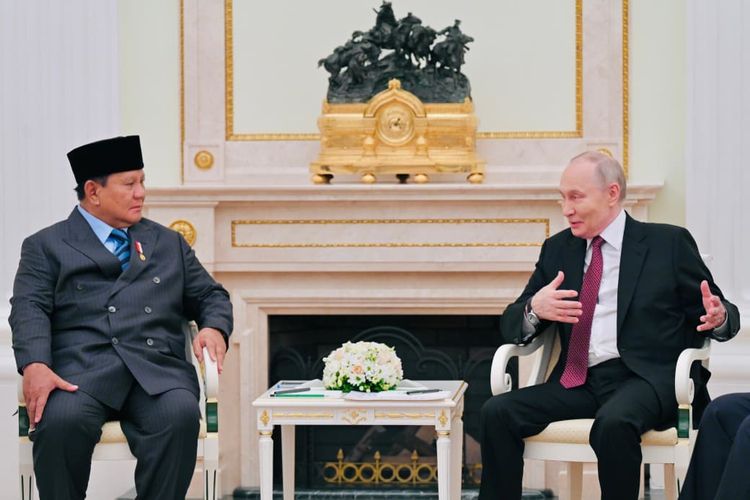
The meeting between the President of the Republic of Indonesia, Prabowo Subianto, and the President of the Russian Federation, Vladimir Putin, at the Kremlin Palace in Russia on 10 December 2025 was not merely a ceremonial encounter between two countries long acquainted with one another. It also signaled a new direction in Indonesia’s foreign policy—rooted in Pancasila and Asta Cita.
Amid a world that is increasingly multipolar and marked by friction among blocs, Indonesia is present not as a follower of prevailing currents, but as a middle power that insists on its own sovereign space. The alignment between the spirit of Pancasila—especially the principle of national unity and the commitment to lasting peace—and the Asta Cita vision of economic self-reliance, strong defense, and sovereign diplomacy provides Indonesia with both a moral and strategic foundation to manage relations with multiple global powers without losing its identity.
President Prabowo’s arrival—personally welcomed by senior Russian officials, including the Kremlin’s Supreme Commander Sergey Udovenko and Deputy Foreign Minister Andrey Rudenko—underscored Moscow’s serious attention toward Jakarta. This high-level protocol was not merely symbolic; it reflected Russia’s view of Indonesia as an important force in the Indo-Pacific region.
In recent years, the Indo-Pacific has increasingly resembled a stage for strategic rivalry among the United States, China, and various regional alliances seeking to preserve influence. In such an uncertain global atmosphere, every diplomatic gesture carries deep geopolitical meaning. In Southeast Asia, only a few countries receive similar treatment at the Kremlin—making Indonesia’s position stand out even more clearly.
The meeting did not address bilateral interests alone. It also reflected how Indonesia is building a firmer geopolitical identity: open to multi-directional cooperation, refusing to be trapped in the politics of polarization, and reaffirming the “free and active” principle—now expressed as strategic autonomy amid great-power competition. Indonesia seeks to ensure it is not positioned as an object in the game of major powers, but as a subject with its own political will.
Grounded in the ethical foundations of Pancasila—particularly the value of just and civilized humanity and the aspiration for peaceful international relations—Indonesia possesses moral space to engage in dialogue with anyone without ideological burdens. President Prabowo therefore came to the Kremlin carrying a clear message: Indonesia is willing to cooperate with any party so long as such cooperation reflects justice, equality, and shared interests. This keeps Indonesia’s foreign policy honorable and acceptable to diverse partners, including those beyond Jakarta’s traditional orbit.
Viewed more broadly, this step demonstrates Indonesia’s capacity to maintain balance between diplomatic ethics and geopolitical realities. The world is moving toward a new order that has not yet been fully defined, and in this situation Indonesia chooses navigation anchored in Pancasila values and the Asta Cita vision as its strategic compass.
A Symbol of Strategic Trust
One of the most important parts of the meeting was the tête-à-tête session between President Prabowo and President Vladimir Putin. Tête-à-tête—a French loan phrase that literally means “head-to-head” or “face-to-face”—refers to a private conversation. It is a format not granted to every head of state.
In high-level diplomacy, a tête-à-tête is a symbol of strategic trust: a quiet space where two leaders can speak without the filters of protocol, without technical staff interruptions, and without rigid formal constraints. It is precisely the kind of room where the most sensitive interests can be mapped—ranging from Indo-Pacific stability to the increasingly complex navigation of global geopolitics.
In this context, Indonesia was present not merely as a state guest, but as a strategic actor viewed as an equal by Moscow. In that private discussion, Indo-Pacific issues were almost certainly among the main agendas. As an archipelagic state located at the crossroads of global trade routes and a new center of gravity in global geopolitics, Indonesia has an interest in ensuring the region remains stable, open, and free from domination by any single power.
Russia, which has been shifting its strategic orientation toward Asia following prolonged tensions with the West, views the Indo-Pacific as a space to expand economic, military, and political networks. The tête-à-tête enabled both leaders to align perspectives on how cooperation can be built without heightening regional tensions—an especially relevant dialogue given growing rivalry among the United States, China, and various regional alliances.
From Indonesia’s national interest perspective, the private conversation was an opportunity to reaffirm the principle of strategic autonomy that now forms the foundation of Jakarta’s foreign policy. Indonesia seeks to ensure Russia understands its position: Indonesia is not within anyone’s orbit, but offers an equal partnership based on mutual interests.
A historical dimension strengthens this trust. Indonesia–Soviet relations during President Soekarno’s era showed how both countries once cooperated in building strategic bases, technology sectors, and defense capacity. Today, the relationship is evolving into a more modern, pragmatic, and complementary partnership—especially in the context of Indonesia’s need to strengthen energy resilience and defense technology.
At the regional level, the tête-à-tête reflects how Indonesia plays the role of a natural balancer in Indo-Pacific dynamics. As the largest country in Southeast Asia and a strategic axis within ASEAN, Indonesia strives to prevent the region from being pulled too far toward one great-power pole. By opening space for intensive dialogue with Russia, Indonesia broadens ASEAN’s diplomatic horizon—while asserting that the region must not become an arena of influence competition without regard for the voices of countries within it.
This step shows how Indonesian diplomacy operates simultaneously: preserving regional stability, strengthening bargaining power, and maintaining strategic autonomy amid global competition. All of this is anchored in Pancasila values as a moral compass and as the strategic framework of Indonesia’s diplomacy.
Principles of humanity, social justice, and commitment to world peace are reflected in Indonesia’s preference for dialogue over confrontation; partnership over dependency; and balance over polarization. The tête-à-tête thus becomes a concrete expression of how Indonesia translates Pancasila into modern geopolitics—choosing an upright, open, and sovereign path in an increasingly fragmented world, while playing a constructive role at both regional and global levels.
Leader-to-Leader “Chemistry”
Moreover, the luncheon hosted by President Putin in honor of President Prabowo went beyond protocol. It became a symbolic arena where personal nuance and diplomatic gestures generate social capital that can lead to real decisions. At the same table, smiles, hand gestures, and light conversation soften formal tension and create space for interpersonal trust—an essential condition when sensitive agendas are to be discussed later.
Such symbolism is not decoration; it is a political tool that smooths technical lobbying, opens doors for working-level teams, and accelerates negotiations that often move slowly in formal settings. In Indonesia’s Pancasila-based approach, the luncheon also represents civilized diplomacy: respect as the beginning of a fair and mutually respectful partnership.
Personal rapport between leaders often becomes a catalyst for more substantive bilateral cooperation. History shows how leader-level chemistry can accelerate strategic alignments or ease compromises—from Roosevelt and Churchill to effective regional relationships. Prabowo and Putin—both seen as firm figures oriented toward stability—can leverage personal proximity to agree on concrete steps in investment, technology transfer, and well-structured defense cooperation schemes.
When communication at the top is smooth, negotiation mechanisms below—energy contracts, infrastructure projects, and research cooperation frameworks—tend to gain faster, more implementable momentum.
Bilateral implications of the luncheon include tangible agenda horizons: energy (supply and investment), maritime industry, food and strategic commodity supply chains, as well as defense technology and know-how transfer. For Indonesia, a strengthened partnership with Russia can reduce dependency on a single market and expand diversification options—an important aspect of economic sovereignty and national security.
Practically, the relaxed meeting also functioned as a starting point for technical discussions on licensing, joint ventures, and medium- to long-term financing schemes—matters that directly affect welfare and domestic industrial capacity.
This meaningful luncheon must also be read through regional and global geopolitical lenses. The Indo-Pacific is now an arena of multipolar competition, where middle-power policy is influenced by the dynamics of great powers and regional alliances. Indonesia must ensure that stronger bilateral relations with Russia do not diminish its central role within ASEAN nor its ability to act as a regional balancer.
At the global level, intensive cooperation with one party must also be designed carefully to avoid negative consequences—such as impacts on third-market access or the risk of regional interests being drawn into broader rivalries.
Indonesia as a Central Actor
The Prabowo–Putin meeting took place amid rising global tension, as U.S.–China rivalry increasingly sharpens divisions within the international order. At the same time, Russia is strengthening its geopolitical orientation toward Asia in response to prolonged resistance from Western countries toward Moscow’s policies.
The Indo-Pacific has thus emerged as the main stage of 21st-century competition—where trade routes, energy, technology, and military security intersect and shape the future direction of the world. It is therefore not excessive to read the Prabowo–Putin meeting as an important maneuver within a rapidly shifting strategic landscape.
In these dynamics, Indonesia can no longer stand merely as an observer. With a geostrategic position connecting the Indian and Pacific Oceans, the world’s fourth-largest population, and a steadily growing economy, Indonesia is a central actor closely watched by all major powers. The Prabowo–Putin meeting indicates that Indonesia has chosen to play an active role in shaping an Indo-Pacific architecture that is peaceful, stable, and inclusive—an entirely rational choice for a country that understands its future depends on navigating an increasingly unfriendly global environment.
In this process, Pancasila again becomes the moral and political compass guiding Indonesia’s foreign policy direction. The principle of just and civilized humanity, along with commitment to world peace, grants Indonesia legitimacy to act as a communication bridge among major powers that are increasingly distancing themselves from one another.
Indonesia has no interest in worsening regional tensions; rather, stability is a critical prerequisite for national agendas such as industrialization, downstream resource processing, and digital transformation. Without regional stability, Indonesia’s ambitious plan to move up the global economic ladder will continue to face obstacles.
Thus, cooperation with Russia becomes a sensible strategy of partner diversification. Dependence on a single power bloc is a strategic risk for a country as large as Indonesia; opening new cooperation channels with Russia expands maneuvering space and strengthens Jakarta’s bargaining position.
Russia has capabilities in energy, defense technology, food technology, and space—fields relevant to Indonesia’s long-term development agenda. Diversifying cooperation also makes Indonesia more resilient amid rapidly changing global economic and security dynamics.
For Russia, Indonesia is not only a bilateral partner, but also a strategic gateway to Southeast Asia—a region emerging as a new center of the world economy and an important arena of global influence competition. If followed by measured implementation steps, the meeting can produce more pragmatic and mutually beneficial cooperation: Indonesia strengthens strategic autonomy, while Russia gains greater access to a region previously relatively outside its geopolitical orbit.
Accordingly, the Prabowo–Putin meeting carries significance not only for the two countries, but also for the regional and global geopolitical configuration searching for a new equilibrium.
The meeting not only strengthens political chemistry at the leadership level, but also opens the way for structural, long-term cooperation. In a global landscape moving toward new multipolarity, intensifying bilateral relations of this kind gives Indonesia room to strengthen its bargaining position amid great-power rivalry.
In the defense sector, opportunities for modernizing major weapons systems become a relevant focus. Indonesia is currently pursuing a diversification strategy to ensure national defense self-reliance, and Russia—with its long tradition in military technology—offers cooperation potential beyond transactional deals. Joint production approaches, technology transfer, and enhancement of domestic defense industry capability are increasingly realistic agendas. This aligns with President Prabowo’s vision of building a strong, flexible defense posture able to adapt to regional challenges.
In energy, broader cooperation becomes a long-term strategic need. Russia has capabilities in oil and gas exploration, as well as experience in developing nuclear energy for peaceful purposes. These are highly relevant for Indonesia as it pursues energy resilience, strengthens strategic reserves, and seeks diversification of supply sources. Such energy collaboration is not only an economic matter, but part of Indonesia’s geostrategy to secure supply stability in a volatile world.
At the same time, potential cooperation in food technology, space technology, and education opens another strategic dimension. History shows that many Indonesian technicians, scientists, and officers have studied in Russia, providing a proven foundation of trust. Amid global technological competition, strengthening academic and research cooperation can create a new generation of Indonesian technocrats capable of competing globally, supporting a knowledge-based national economic transformation.
Within the framework of Pancasila values—especially social justice and national unity—such partnerships can strengthen Indonesia’s national resilience while expanding adaptive diplomatic networks amid global uncertainty.
Ultimately, the Prabowo–Putin meeting is not merely a diplomatic chapter, but a chapter of history: Indonesia is determining its position in a new multipolar world order—filled with challenges, yet also rich with opportunities for a country courageous enough to negotiate its own future.
Prof. Dr. Ermaya Suradinata, SH, MH, MS
Rector of IPDN (2015–2018); Former Director General of Socio-Political Affairs, Ministry of Home Affairs of the Republic of Indonesia (1999–2001); Former Governor of the National Resilience Institute (LEMHANNAS RI) (2001–2005)
 English
  Indonesian