Pancasila as a Compass for Disaster Management Toward a Greater Indonesia
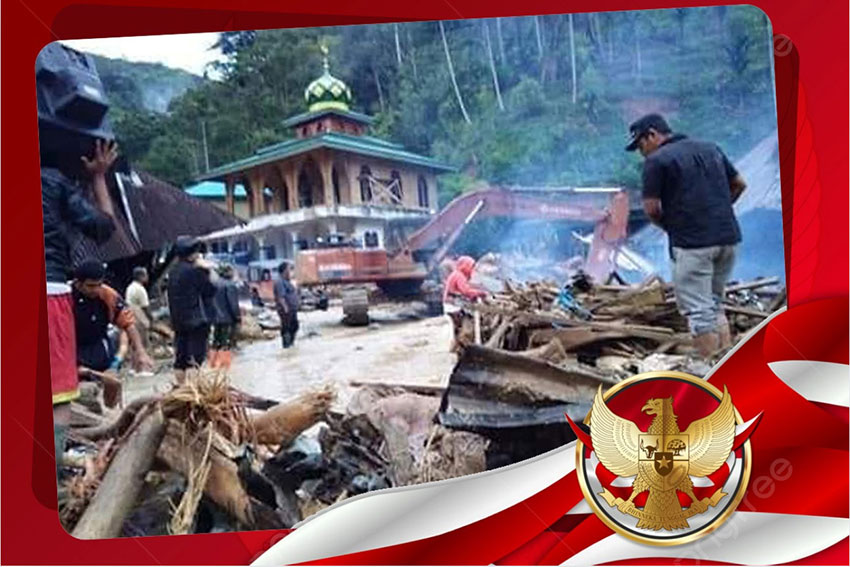
Recently, Indonesia has experienced floods and landslides in Aceh, North Sumatra, and West Sumatra. In Aceh, the death toll reached 391, and 31 people were reported missing. North Sumatra recorded 1.6 million affected residents, with 339 deaths and 107 missing. Meanwhile, in West Sumatra, 256,681 people were affected, with 235 deaths and 93 reported missing. In terms of economic losses, the Center of Economic and Law Studies (Celios) estimated the national economic impact at IDR 68.67 trillion.
In 2025, Indonesia has been gripped by natural disasters—as if enduring a long season in which nature speaks with a voice that cannot easily be ignored. Even the rain that falls day after day seems to carry a moral weight—as if testing how far this nation can maintain balance between development and respect for its own living environment. The winds that sweep coasts and mountains convey more than mere shifts in weather; they remind us that the relationship between humans and nature is ethical, not merely mechanical.
The National Disaster Management Agency (BNPB) noted nearly 2,919 disaster events from January to 24 November 2025, the majority hydrometeorological. Floods and landslides in Sumatra displaced thousands of residents, and Mount Semeru’s eruption once again shook the lives of communities on its slopes. All of this unfolds as global risk indices continue to place Indonesia among the most vulnerable countries.
In this recurring reality, Pancasila finds its deepest relevance: as a foundation for ecological wisdom, human consciousness, and a guide that refuses to separate human safety from the integrity of the natural landscape that sustains it. Thus, amid this encirclement of disasters, it becomes clear that risk management cannot be built solely on rapid response or sophisticated equipment. It requires a values-based compass that guides the nation to view disasters as moral events, not merely technical ones.
When thousands of citizens are displaced; when overflowing rivers erase the traces of households; when mountains send scorching clouds, the state is called not only to act swiftly, but to act with justice, empathy, and an awareness of national brotherhood. Pancasila, as the ethical foundation of shared life, demands that every disaster policy be born from respect for human dignity, the spirit of togetherness, and responsibility toward fellow citizens.
Here, values become an invisible infrastructure—no less important than embankments, risk maps, or early warning systems. They guide the state not only to save human bodies, but also to calm human spirits, and to ensure disasters do not further sharpen lines of social division. If we examine the chain of events throughout the year, it becomes evident that damage is not caused solely by natural phenomena, but also by collective decisions that create space for vulnerability.
Deforestation in upstream watersheds, settlement expansion into hazard zones, urban planning that eliminates infiltration areas, weak early warning systems, and uneven capacity among local disaster management agencies (BPBD)—all form a pattern showing that risk is not only something that comes from outside, but also something that is produced. This is a mirror demonstrating that disaster governance cannot be understood without a foundation of public ethics.
Pancasila underlines that safety is a right, not a matter of luck; that justice is not an optional add-on, but the core of national resilience; and that togetherness does not end with spontaneous solidarity, but must be embodied in systems that protect the most vulnerable. Therefore, integrating values into policy must penetrate development planning.
Within the National Medium-Term Development Plan (RPJMN), regional regulations, and technical documents, indicators of social justice, citizen participation, budget transparency, and sustainable spatial planning must become prerequisites for mitigation funding. Disaster approaches can no longer be centered downstream—only when water has already risen or the ground has already shifted. Upstream mitigation—reforestation, ecosystem restoration, and the normalization of hydrological functions—is a form of state responsibility toward generations living today and tomorrow. Fiscal alignment in favor of upstream ecology is not merely a technical program; it is a moral statement that human safety and environmental sustainability must not be separated.
Accordingly, Pancasila—in its philosophical meaning—demands operational togetherness: the state must be present as a body moving in unison, even though it consists of many organs. Policies from the top will not be effective without strength from below. Local communities must be positioned as the first spearhead to read danger signs: water flows that change color, different sounds from the mountain, unusual animal behavior.
This local knowledge is social capital that must be respected. Therefore, community-based preparedness programs—local SAR training, participatory risk maps, and early warning systems in local languages—must not be viewed merely as empowerment efforts, but as pillars of national safety.
The values of Pancasila live in such spaces, when citizens are involved not as objects, but as subjects of policy. In the same spirit, transparency and accountability become moral responsibilities. Aid distribution must be protected from political interests. The involvement of local parliaments (DPRD), civil society organizations, and independent media must ensure that assistance reaches those who need it most.
Pancasila teaches that disasters must not become a stage for symbolic struggles over power; human suffering must not be processed into political commodities. Thus, Pancasila offers something that technical protocols do not possess: a moral reason to protect human beings. It helps the nation understand that disasters are not only about survival or loss, but about whether the state is truly present as a protector.
Pancasila becomes the compass that keeps this nation walking in the right direction—so that system reform does not lose its soul, so that recovery does not lose its sense of justice, and so that Indonesia Raya, even when struck by a heavy season of disasters, does not lose its light on the long journey toward a future that is stronger, fairer, and more humane.
Prof. Dr. Ermaya Suradinata, SH, MH, MS
Rector of IPDN (2015–2018); Former Director General of Socio-Political Affairs, Ministry of Home Affairs of the Republic of Indonesia (1999–2001); Former Governor of the National Resilience Institute (LEMHANNAS RI) (2001–2005)
 English
  Indonesian