The Role of Geopolitics in Thawing the Rigidity of State Bureaucracy
In essence, bureaucracy within a Pancasila-based state was never intended to function merely as an administrative instrument operating within rigid procedural confines. Rather, it is meant to serve as an extension of the state’s ethical foundation—rooted in social justice, humanity, and unity. Bureaucracy represents the tangible face of the state in the daily lives of citizens, where justice is tested not through rhetoric, but through concrete public service.
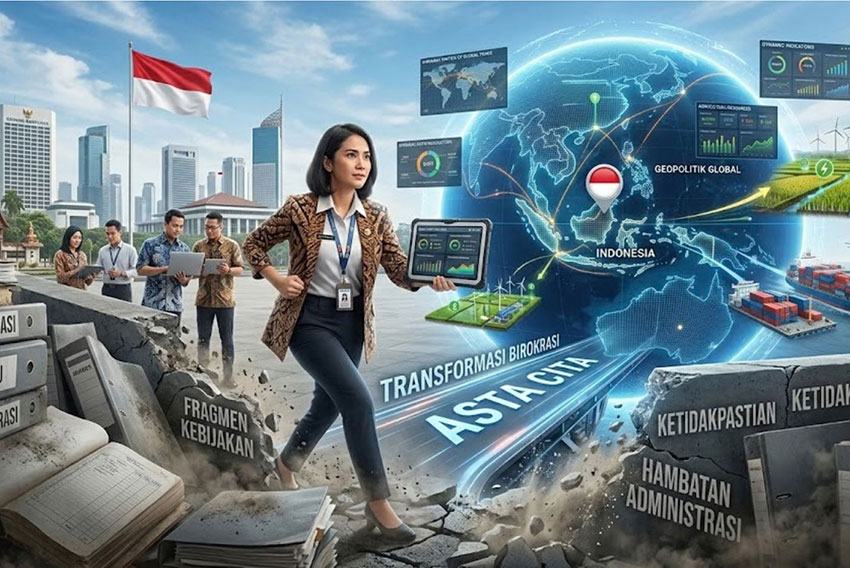
When bureaucracy fails to transform, it is not only the quality of public services that deteriorates, but also the state’s resilience in facing increasingly intense and unpredictable global competition. In a world moving toward great power rivalry, administrative capacity becomes an integral component of national power. Therefore, the transformation of the civil service must be understood as a strategy of national resilience, not merely a technocratic agenda.
The call for reform delivered by Minister of Home Affairs Muhammad Tito Karnavian during the inauguration of the Vice Rectors of the Institute of Public Administration (IPDN), Primary High Leadership Officials, and Administrative Officials at the Sasana Bhakti Praja Building, Ministry of Home Affairs Headquarters in Jakarta (Thursday, February 12, 2026), finds its relevance as a call to recalibrate central–regional relations in alignment with a comprehensive vision of sovereignty.
Accordingly, the policy direction of President Prabowo Subianto’s administration through the Asta Cita framework must be situated within an increasingly competitive geopolitical landscape. Food security, energy security, and economic resilience are not merely domestic agendas; they are strategic responses to global supply chain volatility, energy conflicts, and technological wars.
In this context, bureaucracy is not simply a program executor, but a policy architect that determines whether Indonesia becomes an active player or merely a market in global competition. Without strong cross-sector coordination—from agriculture, spatial planning, logistics, and industry to innovation—national policies will become fragmented and lose their geopolitical bargaining power.
Moreover, contemporary geopolitics is determined not only by military strength but also by institutional capacity. States capable of managing data, integrating policies, and consistently executing programs will hold stronger positions in international negotiations. Here, an adaptive bureaucracy becomes a geopolitical instrument.
When Indonesia can ensure food supply stability, energy independence, and industrial resilience, its diplomatic standing will strengthen. Conversely, a slow and fragmented bureaucracy will render the state vulnerable to external pressures, whether through import dependency, price volatility, or unbalanced foreign economic penetration.
Governance indicator systems form the operational foundation of such transformation. Instruments such as the Indonesian Democracy Index and the KPK Monitoring Center for Prevention not only measure democratic quality—through civil liberties, political participation, and governance—but also reinforce state legitimacy in the eyes of the public and the international community. Measured and transparent democracy enhances investor confidence, strengthens political stability, and reduces geopolitical risk.
In other words, democracy indicators are not merely domestic evaluation tools but reputational capital within the international system. Likewise, governance effectiveness supported by SMART-based performance indicators (Specific, Measurable, Achievable, Relevant, Time-bound) establishes structured goal-setting to ensure that objectives are clear, measurable, realistic, relevant, and time-bound.
Within a geopolitical framework, the ability to measure and execute policies with precision constitutes a form of state power. A state that demonstrates consistent bureaucratic performance will be more trusted in international cooperation, stronger in trade negotiations, and more resilient against external pressures.
At the same time, Pancasila provides moral direction for this process. The principle of social justice demands that development not only increase economic growth but also reduce regional disparities. Regional inequality is not merely a domestic issue but a geopolitical risk, as it can create social vulnerabilities that weaken national cohesion.
With measurable performance indicators, equitable development can be systematically monitored and prevented from remaining mere political rhetoric. Bureaucratic integrity becomes an absolute prerequisite for the success of this agenda. Corruption is not only a legal violation but also a geopolitical threat, as it weakens fiscal capacity, erodes public trust, and opens space for external intervention.
Bureaucratic transformation must also leverage digital technology and open space for youth participation. In the era of the digital economy and artificial intelligence, decision-making speed becomes a key determinant of competitiveness.
Transparent electronic-based governance systems will enhance efficiency, reduce transaction costs, and strengthen public trust. Regional autonomy must be understood as the decentralization of capacity to collectively reinforce national resilience, not as policy fragmentation that weakens central–regional coordination.
Thus, bureaucracy without transformation constitutes a real threat to sovereignty, creating a state strong in symbolism but weak in substance. Indonesia cannot rely solely on its abundant natural resources; it requires adaptive, integrity-driven, and results-oriented institutions.
Pancasila and Asta Cita have provided normative and strategic direction, while SMART-based performance indicator systems offer operational instruments to translate that direction into tangible, measurable, and people-centered policies. In an increasingly competitive world, state power is measured not only by the abundance of resources, but by the quality of its institutions.
It is therefore clear that bureaucratic transformation is a geopolitical pathway to ensure that Indonesia’s sovereignty is not merely proclaimed in international forums, but truly experienced in the daily lives of all its citizens.
Prof. Dr. Drs. Ermaya Suradinata, SH, MH, MS, is an observer of geopolitics, geostrategy, and public administration management.
 English
  Indonesian