
In Memoriam Try Sutrisno: Grounding Pancasila Amid the Storm of Global Geopolitics
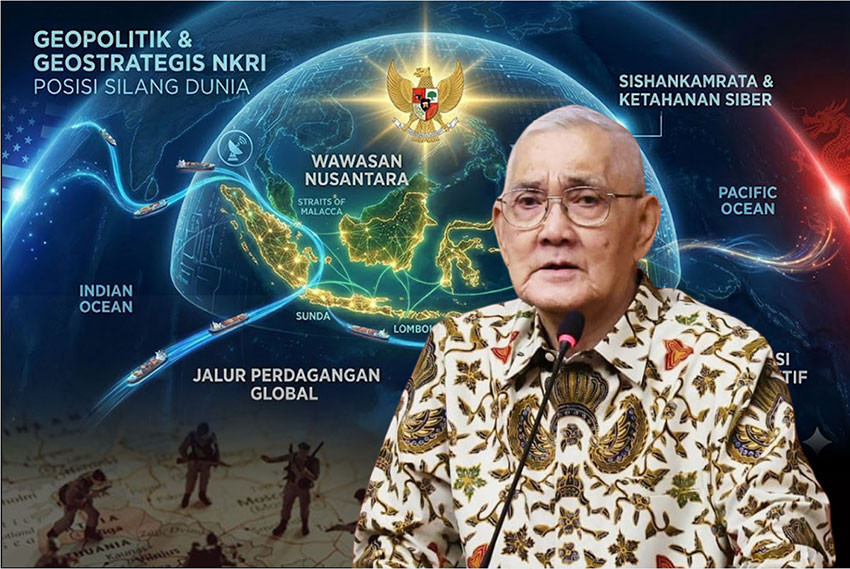
Indonesia has once again lost one of its finest sons. Try Sutrisno passed away on Monday, March 2, 2026, at 06:58 WIB at RSPAD Gatot Soebroto at the age of 90. The passing of the 6th Vice President of the Republic of Indonesia brings deep sorrow, but more than that, it invites reflection on the national foundation he consistently upheld throughout his life: Pancasila, the ideology that serves as the foundation of the Indonesian state, which was derived from the cultural and philosophical roots of Indonesia by the country’s first President, Ir. Soekarno.
During his lifetime, I worked with him for a short time at the Pancasila Ideology Development Agency (BPIP). Retired TNI General Try Sutrisno served as Deputy Chair of the BPIP Steering Committee, which was led by Chair Prof. DR. (H.C) Hj. Megawati Soekarnoputri, who was also the 8th Vice President and 5th President of Indonesia. He is assisted by several members of the Steering Committee, as well as the Head of BPIP, Prof. Drs. KH. Yudian Wahyudi, and several other leaders. The strengthening of the Pancasila ideology, democracy, and human rights is used as a guideline in President Prabowo Subianto’s Asta Cita in the Red and White Cabinet
In an increasingly uncertain global landscape—marked by rivalries between major powers, economic fragmentation, regional conflicts, and even wars of narrative in the digital space—the commitment to grounding Pancasila has found its urgency. And it is at this point that Try Sutrisno’s moral legacy becomes relevant to reflect upon once again. At the same time, the strength of the state must be rooted in a solid ideology. National stability is not only a matter of physical defense or political order, but also ideological resilience.
Throughout Try Sutrisno’s service to the nation and state, this commitment found further expression through the Pancasila Ideology Development Agency (BPIP). As Deputy Chair of the BPIP Steering Committee, Try Sutrisno was known for his discipline and integrity in promoting the implementation of Pancasila. He did not view Pancasila as a historical document, but rather as a living ideology that must continue to be translated into public policy, governance, and the behavior of citizens.
Amidst growing global polarization—between extreme market liberalism, narrow nationalism, and identity-based radicalism—Try Sutrisno views Pancasila as a middle ground rooted in Indonesia’s own historical experience. Moreover, today’s global geopolitics is moving in a vortex of uncertainty that shows no sign of abating. Tensions between Iran and the United States-Israel axis have reignited the Middle East, the Israeli-Palestinian conflict has yet to find a just solution, while the Russian-Ukrainian war continues to shake the stability of Europe and the global energy supply chain.
In South Asia, friction between Pakistan and Afghanistan has left regional security issues unresolved, while the dynamics between Thailand and Cambodia demonstrate how fragile relations between countries can be when nationalist sentiments are not managed wisely. In this landscape, the world seems to have lost its moral anchor; international relations are driven solely by the logic of power and interests. The domino effect spreads to the economy, food, energy, and even public trust in a just world order.
It is in this context that Try Sutrisno’s legacy finds its relevance. He believed that Pancasila was the moral and strategic compass of the nation. For Try, Pancasila is not only a symbol of internal unity, but also an ethical foundation for how Indonesia views and responds to the world. While other countries are caught up in bloc politics and transactional calculations, Indonesia is required to remain steadfast in its principles of humanity, justice, and sustainable peace.
When read deeply, Pancasila actually offers an ethical horizon that transcends Indonesia’s territorial boundaries. The principle of Belief in One God affirms respect for human spiritual dignity without imposing its hegemony; the principle of Just and Civilized Humanity rejects violence and oppression in any form; the principle of Indonesian Unity teaches that collective identity can be built without negating diversity; the principle of Democracy emphasizes the importance of deliberation over domination; and the principle of Social Justice demands an equitable distribution of welfare.
When contextualized within the global order, these values can serve as an alternative ideological offering amid the failure of extremism, uncontrolled liberalism, and narrow nationalism. Pancasila was not born out of hegemonic ambitions, but rather from the historical experiences of a diverse nation—and it is precisely because of this that it has the potential to become a global inspiration. Therefore, in order for Pancasila to have global resonance, it must first be firmly established at home. The implementation of Pancasila that Try fought for has a domestic dimension that is inseparable from Indonesia’s global role.
National resilience in the era of globalization cannot be built solely through economic growth, but through social cohesion and public trust in the state. Political polarization, digital disinformation, and identity politics can become loopholes that weaken Indonesia’s bargaining power on the international stage. Therefore, strengthening the internalization of Pancasila values through education, bureaucratic reform, and elite role models is an absolute prerequisite.
Amidst ongoing wars and recurring tensions, the world needs more than just a balance of power; it needs a balance of values. Indonesia may not be a military superpower, but it has a unique ideological strength. In a world that tends to be transactional and polarized, consistency with Pancasila can be Indonesia’s contribution to civilization: presenting a middle ground, caring for humanity, and affirming that true peace is born of justice.
With global geopolitical turmoil showing no signs of abating, Indonesia needs more leaders and citizens who make Pancasila a way of life, not just ceremonial rhetoric. “In Memoriam Try Sutrisno” is not only a record of grief, but also a call for us not to lose our direction.
If we consistently uphold and implement Pancasila, Indonesia will be able to create political, monetary, and fiscal stability, thereby establishing the nation’s independence, not only as a country that survives, but as a nation that plays a meaningful role in the world geopolitical arena.
Prof. Dr. Drs. Ermaya Suradinata, SH, MH, MS
Observer of Geopolitics, Geostrategy, and Government Management.
 English
  Indonesian