Safeguarding National Sovereignty Amid the Middle East War and Global Geopolitical Turbulence
The world today is moving through an increasingly evident period of uncertainty. Geopolitical tensions are emerging across various regions, global supply chains are being disrupted, energy and food prices are fluctuating, and rivalries among major powers are intensifying. In such circumstances, a nation’s sovereignty is no longer measured solely by its ability to defend its territory militarily, but also by its economic resilience, social stability, and diplomatic intelligence in interpreting global changes.
Within Indonesia’s constitutional framework, the concept of sovereignty has been clearly emphasized from the very beginning. Article 1 paragraph (2) of the 1945 Constitution states that “sovereignty resides in the hands of the people and is exercised in accordance with the Constitution.” This provision affirms that all directions of state policy must ultimately be grounded in the interests of the people and implemented within a constitutional framework.
Sovereignty is not merely a political symbol; it is a mandate that must be realized through the state’s ability to maintain stability, protect national interests, and ensure the welfare of society. Therefore, amid increasingly complex global dynamics, Indonesia must reaffirm its position as a sovereign nation through a combination of an independent and active foreign policy and the strengthening of domestic resilience.
This approach becomes increasingly relevant as the world enters a phase of more intense geopolitical competition. The ongoing war between Russia and Ukraine has affected global energy and food stability. In the Middle East, the escalation of tensions involving Iran, Israel, and the United States has increased the risk of broader conflict. This region serves as one of the world’s main energy distribution centers, meaning that any military escalation can quickly influence global oil prices and international economic stability.
Tensions are also emerging in other regions. In South Asia, security dynamics between Pakistan and Afghanistan continue to generate uncertainty along border areas. In Southeast Asia, relations between Thailand and Cambodia have once again heated up due to unresolved territorial disputes. Meanwhile in East Asia, rivalry between China and Japan has intensified following the implementation of various reciprocal economic and security restrictions.
These series of conflicts indicate that the world is entering a new era: geopolitical competition that no longer occurs solely through direct military confrontation, but also through economic warfare, technological rivalry, and the strengthening of strategic alliances. Such an international environment creates particular pressures for developing countries whose economies remain highly dependent on the stability of global trade.
In this situation, Indonesia’s ability to maintain an independent foreign policy becomes critically important. The principle of an independent and active foreign policy provides Indonesia with the space to cooperate with various countries without becoming trapped in geopolitical rivalries that could potentially harm national interests. This diplomatic flexibility allows Indonesia to maintain strategic relationships with various global powers while preserving its position as a nation that prioritizes regional stability.
However, international diplomacy alone is not sufficient to ensure that national sovereignty remains safeguarded. True sovereignty also rests upon strong domestic foundations. In this context, strengthening the national defense system becomes one of the key pillars that cannot be neglected. Article 30 of the 1945 Constitution affirms that national defense and security are carried out through a universal defense and security system, with the Indonesian National Armed Forces (TNI) and the Indonesian National Police as the main forces, supported by the people as a supporting component. This principle demonstrates that national defense is not solely the responsibility of military institutions but also the duty of all citizens in safeguarding the sovereignty of the nation.
Beyond defense, the economic dimension is also a crucial factor in preserving national sovereignty. Excessive dependence on food or energy imports can make a country vulnerable to external pressures. Geopolitical crises often disrupt the distribution of strategic commodities, which can directly affect national economic stability.
Indonesia’s Constitution has in fact provided clear direction regarding the importance of economic sovereignty. Article 33 of the 1945 Constitution stipulates that the national economy shall be organized as a common endeavor based on the principle of familyhood, in which sectors of production that are vital to the state and affect the livelihood of the people are controlled by the state. Furthermore, land, water, and the natural resources contained therein shall be utilized to the greatest benefit of the people.
These provisions demonstrate that control over strategic resources forms an essential part of national sovereignty. In addition to food and energy, mastery of technology is also becoming an increasingly decisive factor in global competition. In the era of the digital industrial revolution, a nation’s strength is no longer measured solely by the abundance of its natural resources, but also by its ability to develop advanced technologies.
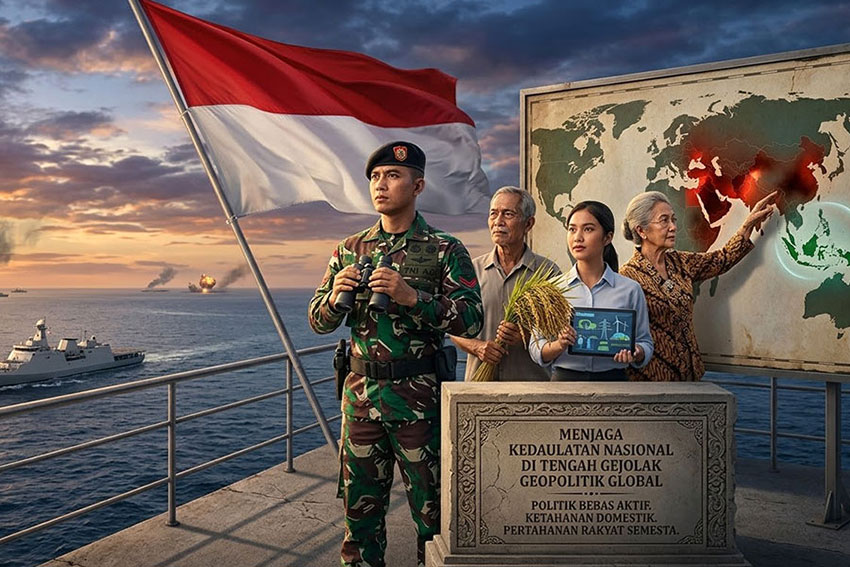
Therefore, safeguarding national sovereignty amid global geopolitical turbulence requires a comprehensive strategy. Intelligent diplomacy, strong economic resilience, and adequate defense preparedness must operate in balance. Indonesia does not need to become involved in rivalries among major powers, but it must strengthen its domestic foundations in order to maintain independence in determining the direction of its national policies.
In an increasingly uncertain world, sovereignty is not merely a political concept; it is the real capacity of a nation to stand firmly in the face of changing times. As long as Indonesia is able to maintain the balance between international diplomacy, economic resilience, and national defense strength, the sovereignty mandated by the Constitution will remain secure amid the currents of global geopolitics.
Prof. Dr. Drs. Ermaya Suradinata, SH, MH, MS
Observer of Geopolitics, Geostrategy, and Government Management.
 English
  Indonesian