Indonesia’s Geopolitics in Facing Global Geopolitical Turbulence
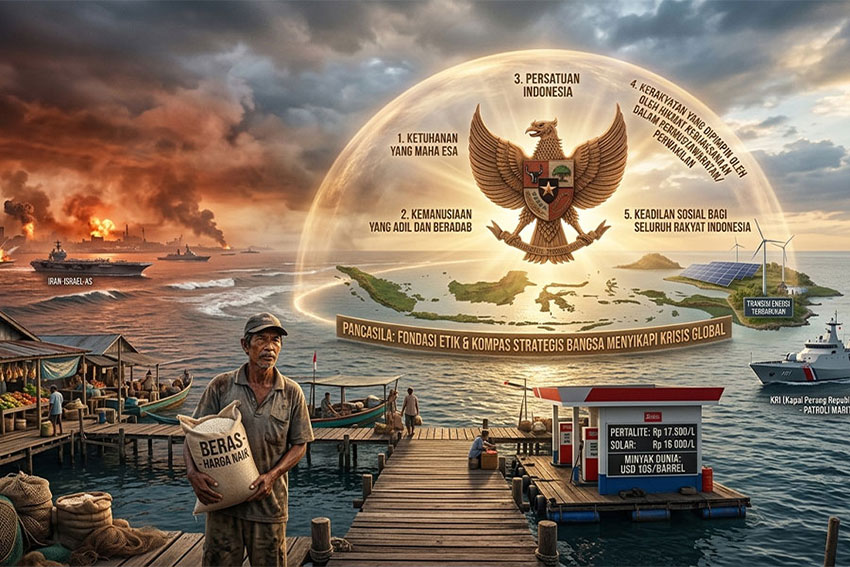
The world seems to have lost its breathing space. In recent days, war in the East is no longer merely a distant and unfamiliar conflict; it has transformed into a massive wave whose vibrations are felt even within the domestic spaces of nations. From Gaza, the flames of conflict have intensified and expanded, alongside a larger confrontation involving Iran, Israel, and the United States.
As military forces confront one another directly, the world is witnessing a shift from a balance-based order toward a landscape of uncertainty that is difficult to predict. In such a situation, Indonesia does not have the luxury of remaining a passive observer. Geopolitics is no longer just an elite discourse, but a concrete reality that determines economic stability, social resilience, and the future direction of the nation.
Amid this uncertainty, Pancasila finds its relevance not merely as a normative foundation of the state, but as a living ethical framework that actively guides action. As the world is shaken by conflict and power-based logic becomes increasingly dominant, Pancasila offers a balance between national interests and humanitarian responsibility. The first and second principles affirm that in responding to crises, Indonesia must not lose its moral orientation.
Pancasila also functions as a strategic compass in maintaining national cohesion amid growing global pressures. The third principle, which emphasizes the unity of Indonesia, becomes increasingly relevant as the impacts of the crisis risk widening disparities across regions and social groups. Rising energy prices, inflationary pressures, and disruptions in logistics distribution are not merely economic variables, but factors that can test national solidarity.
The fourth and fifth principles of Pancasila provide more operational direction in formulating wise and just public policies. Decision-making must be carried out through careful consideration, data-driven approaches, and synergy among state institutions. Responses to crises must not be reactive or short-term, but designed in a measured and sustainable manner. At the same time, social justice must remain the ultimate goal of every policy, ensuring that the burden of crisis is not disproportionately borne by certain groups.
From an empirical perspective, the escalation of conflict in the Middle East has direct implications for global energy stability. The region contributes approximately 30–35 percent of the world’s oil production, with Iran as one of the major producers capable of generating more than 3 million barrels per day under normal conditions. Strategic distribution routes such as the Strait of Hormuz carry around 20 percent of global oil trade daily.
When conflict intensifies, surging oil prices are not merely a possibility but a recurring pattern. At the beginning of 2026, global oil prices moved within the range of USD 95–105 per barrel. For Indonesia, which still imports around 60 percent of its oil needs, this situation places serious pressure on the state budget (APBN), particularly on energy subsidies that in recent years have exceeded IDR 300 trillion.
From the perspective of social justice, rising energy prices cannot be viewed solely as a fiscal issue, but as a challenge of welfare distribution. Data shows that every increase in fuel prices has a direct correlation with inflation, particularly in the transportation and food sectors. In previous episodes, energy price increases have contributed as much as 1–2 percent to annual inflation.
For Indonesia, as an archipelagic nation with more than 17,000 islands, this situation has direct implications for goods pricing and distribution stability. Therefore, strengthening national connectivity becomes a strategic necessity to maintain balanced regional development. On the other hand, geopolitical instability also affects the stability of the national financial sector. In times of global uncertainty, capital tends to flow out of developing countries, putting pressure on the rupiah exchange rate.
To address this complexity, Indonesia requires an integrated strategy that is not only technocratically strong but also rooted in the values of Pancasila. In the energy sector, accelerating the transition toward renewable energy is inevitable. Currently, Indonesia’s renewable energy mix remains around 13–14 percent, still far from national targets.
At the same time, strengthening the domestic economic structure must become a priority. Industrial downstreaming has shown positive results, but it needs to be expanded to other sectors such as agriculture and manufacturing. Food security is a crucial issue, given Indonesia’s continued dependence on imports of several strategic commodities. In times of global crisis, this dependency can become a critical vulnerability affecting price stability and public welfare.
In the defense and diplomatic dimensions, Indonesia is also required to play a more active role. Strengthening defense capacity, particularly in maritime surveillance, is essential given Indonesia’s strategic position along global trade routes. However, this strength must remain aligned with the principle of peace. Meanwhile, Indonesia’s free and active diplomacy provides space to promote dialogue and de-escalation in various international forums.
Behind every crisis lies an opportunity to strengthen the nation’s foundation. By positioning Pancasila as the basis of strategy, Indonesia has a clear direction in facing global uncertainty—not merely to survive, but to grow into a force capable of upholding balance, justice, and sovereignty in an increasingly turbulent world.
Prof. Dr. Drs. Ermaya Suradinata, SH, MH, MS
is an observer of geopolitics, geostrategy, and public administration.
 English
  Indonesian