Indonesia's Sovereignty: A Strategic Challenge for Government Governance
In an increasingly uncertain world, sovereignty has once again become the defining factor of a nation’s future. It is not merely a concept enshrined in the Constitution or a slogan repeated in state addresses. Sovereignty is a nation’s ability to determine its own destiny, manage its resources for the benefit of its people, and safeguard its dignity and national interests amid pressures arising from both external and internal forces.
For Indonesia today, sovereignty represents one of the greatest challenges confronting the administration of President Prabowo Subianto and the Red and White Cabinet. This challenge exists within a highly complex global environment. The world is undergoing rapid and profound transformation. Geopolitical rivalry is intensifying, interstate conflicts continue to emerge, global supply chains are repeatedly disrupted, and advances in digital technology are creating unprecedented opportunities as well as threats unlike any faced by previous generations.
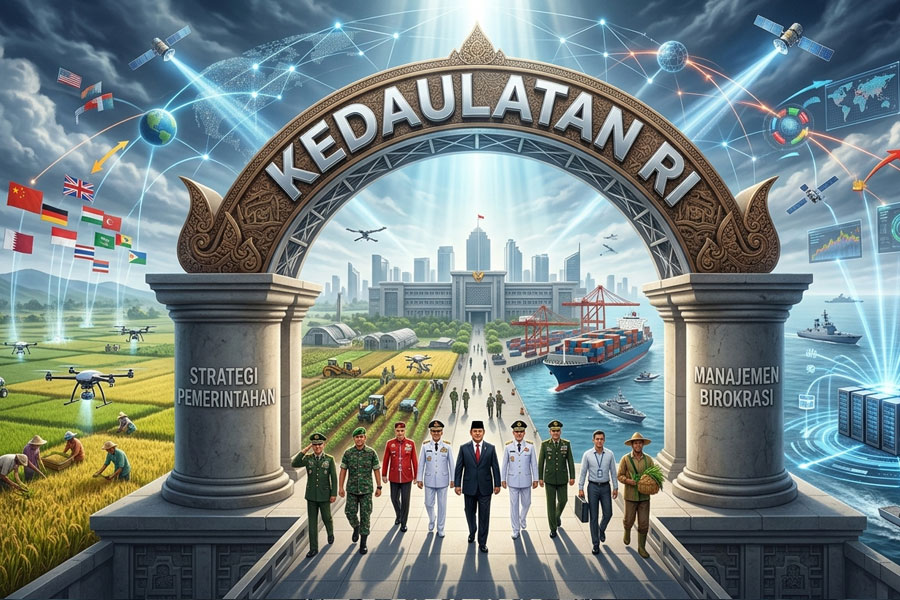
Under these circumstances, safeguarding sovereignty can no longer rely solely on strengthening military defense. Modern sovereignty demands that the state effectively manage its economy, master strategic technologies, preserve social stability, and ensure that the bureaucracy functions efficiently and responds swiftly to an ever-changing environment.
Threats to sovereignty in the modern era rarely occur in isolation. Food insecurity can evolve into a national security issue. Energy dependence may lead to economic vulnerability. Disruptions in cyberspace can undermine political and social stability. Therefore, preserving sovereignty depends largely on the government’s ability to orchestrate coherent and integrated policies, ensuring that all state institutions work toward common national objectives.
In practice, the greatest challenge often lies not in the availability of resources, but in the ability to manage them effectively. Indonesia has been blessed with abundant natural resources, a highly strategic geographical location, and a promising demographic dividend. History, however, has repeatedly demonstrated that resource abundance does not automatically translate into national strength. Many resource-rich countries have struggled to achieve self-reliance because they failed to manage their potential effectively. Ultimately, sovereignty is determined more by the quality of governance than by the sheer quantity of available resources.
This is why the national priorities of food security and energy security carry significance far beyond ordinary development programs. They form the very foundation of national sovereignty. A nation unable to meet its own food needs will remain vulnerable to global disruptions. Likewise, a country that depends heavily on imported energy faces significant risks whenever international instability occurs. Experiences from various global crises consistently show that the countries most capable of withstanding external shocks are those that have achieved a high degree of self-sufficiency in their strategic sectors.
The same principle applies to the maritime sector. As the world’s largest archipelagic nation, Indonesia occupies an exceptionally strategic position. The sea is not merely a geographical space separating islands; it is the strategic domain that unites the nation while serving as a vital source of national strength. Yet this strategic advantage also presents formidable challenges.
Today, the Indo-Pacific region has become one of the world’s most significant geopolitical arenas. Economic, political, and security interests from major powers converge throughout the region. In this context, safeguarding maritime sovereignty involves far more than protecting territorial boundaries. It means ensuring that Indonesia remains the true master of its own waters.
At the same time, the concept of sovereignty has expanded into an invisible domain—the digital space. Whereas threats once came in the form of warships and military force, today they may emerge through cyberattacks, information manipulation, digital espionage, and data theft. National borders become increasingly blurred when information can traverse the globe within seconds. Consequently, protecting national sovereignty in the twenty-first century also means securing data, strengthening digital infrastructure, and fostering a society with sufficient digital literacy to navigate an overwhelming flow of information.
Above all, one factor remains the decisive determinant: the quality of leadership. Strong leadership must be supported by a clean, professional, and effective bureaucracy. This is where public governance reform becomes critically relevant. No matter how ambitious or visionary a government’s development agenda may be, its objectives will remain unattainable if they are obstructed by slow, inefficient bureaucratic processes or compromised by corruption.
Safeguarding sovereignty is not a task that can be completed through a single program or within a single term of government. It is a long-term endeavor requiring consistency, courage, and unwavering commitment. Sovereignty is defended not only along national borders but also in cabinet meeting rooms, public service offices, farmers’ fields, seaports, digital data centers, and within the civic consciousness of every citizen.
Sovereignty is ultimately the result of a nation’s ability to stand on its own feet while maintaining the capacity to cooperate constructively with the international community. Therefore, the greatest challenge facing the Red and White Cabinet is not merely to preserve Indonesia’s political and territorial sovereignty, but to ensure that sovereignty is genuinely reflected in the daily lives of its people.
The truest measure of sovereign government governance is not how forcefully it proclaims its strength, but how effectively it delivers security, justice, and prosperity to all its citizens. It is in this achievement that sovereignty finds its deepest and most meaningful expression.
Prof. Dr. Drs. Ermaya Suradinata, S.H., M.H., M.S.
Observer of Geopolitics, Geostrategy, and Government Management
 English
  Indonesian