
Strengthening and Enhancing the National Defense and Security System to Safeguard the Sovereignty of the Republic of Indonesia
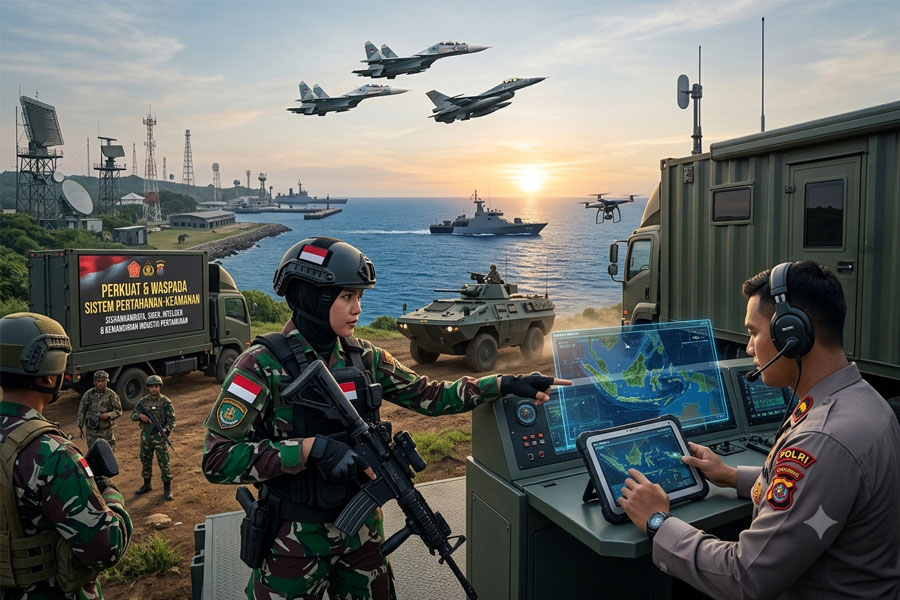
The evolving global security landscape in recent years has demonstrated that threats to national sovereignty no longer arise solely in the form of open military aggression. Geopolitical rivalry among nations, cyber warfare, espionage, disinformation, and competition for economic influence have emerged as new instruments for weakening a country without deploying conventional armed forces.
Amid these developments, Indonesia must no longer regard defense and security as matters exclusively for the military. Rather, they should be understood as a comprehensive national system that requires the readiness of all state institutions and the participation of the entire nation. Article 30 of the 1945 Constitution of the Republic of Indonesia stipulates that national defense and security are implemented through the Universal People’s Defense and Security System (Sistem Pertahanan dan Keamanan Rakyat Semesta, or Sishankamrata), with the Indonesian National Armed Forces (TNI) and the Indonesian National Police (Polri) serving as the principal forces, supported by all components of society.
This constitutional mandate sends a clear message that safeguarding national sovereignty is a shared responsibility that must be realized through comprehensive national preparedness. As the world’s largest archipelagic nation, with vast maritime territory, one of the longest coastlines on earth, and a strategic location between two continents and two oceans, Indonesia requires defense capabilities capable of protecting every part of its jurisdiction.
Strengthening the naval fleet, fighter aircraft, air defense systems, radar capabilities, and unmanned technologies should therefore be regarded as long-term investments in national security. Modern warfare is multidimensional, combining conventional military operations with information warfare, political infiltration, manipulation of public opinion, economic sabotage, and cyberattacks against strategic infrastructure. Such threats may occur without the sound of gunfire, yet they possess the capacity to undermine national stability.
Accordingly, Indonesia’s defense system must be developed comprehensively by integrating military strength, intelligence capabilities, cyber security, economic resilience, and public preparedness to confront various forms of threats. Within this framework, strategic intelligence assumes an increasingly vital role. Intelligence is not merely a tool for gathering information. It functions as an early warning system capable of detecting potential threats before they escalate into national crises.
The ability to analyze geopolitical developments, identify foreign infiltration, map espionage networks, and anticipate threats against national strategic assets constitutes an indispensable component of the country’s defense system. Accurate and timely intelligence enables sound strategic decision-making, while failure to detect emerging threats at an early stage can jeopardize national stability and weaken Indonesia’s position in responding to international pressures.
In the era of digital transformation, vigilance must also extend to cyberspace, which has become a new battlefield. Attacks targeting government networks, national data centers, the financial sector, energy infrastructure, transportation systems, and communications networks can disrupt essential public services while simultaneously threatening national security. The rapid development of artificial intelligence (AI), cloud computing, and the Internet of Things (IoT) presents significant opportunities for national development, but also creates new vulnerabilities that cybercriminals and hostile actors may exploit.
Strengthening the capacity of Indonesia’s National Cyber and Crypto Agency (BSSN), enhancing coordination with the State Intelligence Agency (BIN), the Indonesian National Armed Forces (TNI), and the Indonesian National Police (Polri), as well as accelerating the development of comprehensive cyber security and cyber resilience regulations, have become increasingly urgent priorities. These measures are essential to ensure that Indonesia possesses a digital protection system capable of adapting to rapid technological change.
Strengthening the national defense system must also be supported by a self-reliant domestic defense industry. Excessive dependence on imported defense equipment could create strategic vulnerabilities during international conflicts or disruptions to global supply chains. Consequently, defense modernization policies should be accompanied by stronger investment in research and development, technological innovation, technology transfer, and the expansion of Indonesia’s strategic defense industries.
At the same time, defense diplomacy remains an important instrument for preserving regional stability. Indonesia’s cooperation with France in procuring Rafale fighter aircraft, its acquisition of Multi Role Combat Vessel warships from Italy, and its collaboration with Türkiye in defense technology development demonstrate the country’s continued efforts to strengthen its defense capabilities while maintaining its long-standing doctrine of an independent and active foreign policy. Balanced defense diplomacy enhances deterrence while reinforcing international confidence in Indonesia as a nation committed to peace.
Nevertheless, regardless of the size of the defense budget allocated by the government, national strength cannot be achieved without cultivating a strong sense of civic responsibility among the people. Modern defense is not solely the responsibility of soldiers serving on the front lines. It is equally the responsibility of every citizen to preserve national unity, counter the spread of disinformation, improve digital literacy, and strengthen social resilience against various forms of provocation that seek to divide the nation. In this context, the values of Pancasila, the spirit of national unity, and patriotism serve as the moral foundation that complements the country’s physical defense capabilities.
Safeguarding the sovereignty of the Unitary State of the Republic of Indonesia requires constant vigilance. Threats will continue to evolve alongside technological progress, shifting geopolitical dynamics, and changing global interests. Therefore, Indonesia must continue strengthening its integrated defense and security system through the modernization of defense equipment, enhancement of intelligence capabilities, development of cyber security, expansion of the domestic defense industry, adaptive diplomacy, and the active participation of every component of the nation.
National sovereignty is defended not only through military strength but also through vigilance, unity, and the nation’s ability to anticipate and adapt to changing times. A strong nation is one that remains intelligent, alert, and fully prepared to confront every threat, whether originating from abroad or from within the country, including the activities of foreign intelligence agencies operating domestically. At the same time, it must remain firmly committed to its national development roadmap without losing sight of its direction, identity, or national interests.
Prof. Dr. Drs. Ermaya Suradinata, SH, MH, MS is an Indonesian scholar and observer of geopolitics, geostrategy, and public governance. He is also an alumnus of the U.S. FACOM (now the Indo-Pacific Command), Class of 2002.
 English
  Indonesian