President of the Republic of Indonesia Prabowo Subianto, Civilian Supremacy, National Defense, and Good Governance
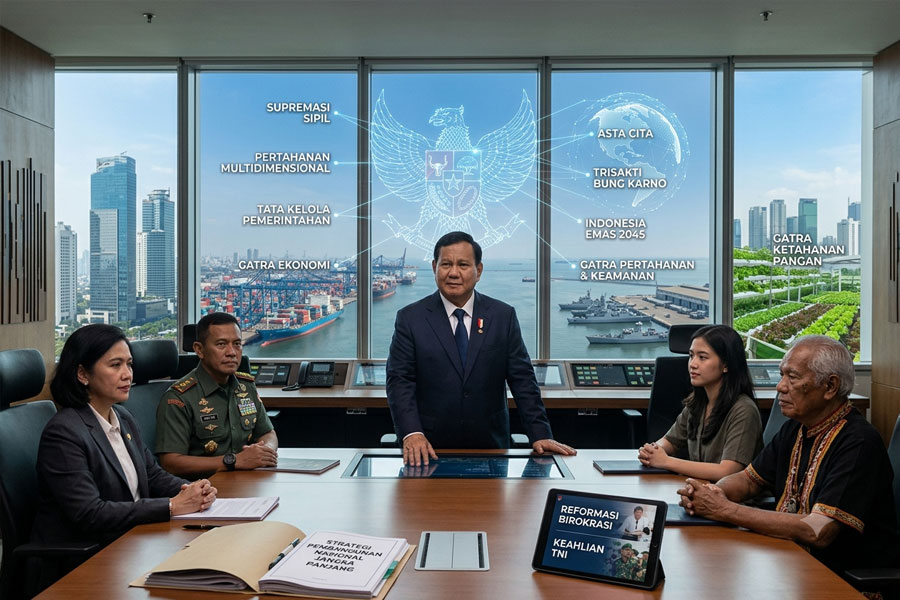
Amid increasingly rapid geopolitical changes, no nation can endure by relying solely on military strength or economic growth. The true strength of a nation lies in national leadership that is capable of uniting all instruments of the state under a single, coherent national vision.
Since its founding, Indonesia has chosen this path through Pancasila as its philosophical foundation, the 1945 Constitution of the Republic of Indonesia as its constitutional framework, and the Archipelagic Outlook (Wawasan Nusantara) as its geopolitical perspective. Within this framework, the President of the Republic of Indonesia occupies an exceptionally strategic position as Head of State, Head of Government, and Supreme Commander of the Army, Navy, and Air Force, as stipulated in Article 10 of the 1945 Constitution.
All elements of the national defense establishment operate under the Constitution, the rule of law, and the will of the people as exercised through the leadership of the President. Modern democracy places the military as a professional instrument of the state, while national policy is determined by civilian leadership that derives its legitimacy from the Constitution. These two institutions are not competitors. Rather, they reinforce one another.
The professionalism of the Indonesian National Armed Forces (TNI) serves as the principal pillar safeguarding national sovereignty, while the President ensures that every defense and security policy remains firmly rooted in the national interest. In this regard, civilian supremacy is fundamentally a constitutional mechanism that maintains the balance between state power, democracy, and the rule of law.
The strategic importance of presidential leadership becomes even more evident as threats to national security extend far beyond conventional warfare. Geopolitical rivalry in the Indo-Pacific, cyber threats, disinformation, terrorism, maritime disputes, climate change, energy insecurity, and disruptions to global supply chains demonstrate that national security has become a multidimensional challenge. Under such circumstances, the President’s role extends beyond serving as Commander-in-Chief in the operational sense. The President must also function as a strategic leader capable of orchestrating all national resources toward a unified national objective.
It is within this context that the concept of National Resilience (Ketahanan Nasional) through the Astagatra framework remains highly relevant. The eight dimensions of national resilience, encompassing geography, natural resources, population, ideology, politics, the economy, socio-cultural affairs, and defense and security, must be integrated into a single, coherent national policy. The President serves as the central integrator, ensuring that all these dimensions develop in harmony so that Indonesia possesses both the resilience and competitiveness needed to face global challenges.
This perspective is fully aligned with President Prabowo Subianto’s Asta Cita, which identifies the strengthening of Pancasila ideology, democracy, national defense, economic self-reliance, human resource development, bureaucratic reform, and clean governance as the principal pillars of national development. Asta Cita demonstrates that defense cannot be viewed in isolation. Rather, it is closely interconnected with the quality of governance, legal certainty, public welfare, and national independence.
A strong nation is not defined solely by the strength of its armed forces. It is equally characterized by a professional bureaucracy, a civil service founded upon integrity, legal institutions that command public trust, and an economy capable of sustaining national strength over the long term. Accordingly, the President’s role as the embodiment of civilian supremacy is to ensure that all of these pillars function harmoniously in advancing Indonesia’s national development.
These principles are deeply rooted in President Sukarno’s doctrine of Trisakti. Political sovereignty means that the state possesses the capacity to make strategic decisions independently, free from external interference. Economic self-reliance requires Indonesia to develop independent industries, including a national defense industry capable of meeting the country’s strategic needs. Cultural identity provides the moral foundation that ensures development never loses sight of Indonesia’s identity as a nation founded upon the values of Pancasila.
As the nation’s leader, the President bears the responsibility of ensuring that political, economic, and defense capabilities develop in balance so that no single sector dominates the direction of national development. It is within this context that good governance assumes critical importance. National defense is not built solely through the procurement of military equipment or increases in personnel. It must also be supported by an effective, transparent, accountable government that is free from the abuse of power.
Good governance creates certainty in long-term planning, promotes fiscal efficiency, strengthens strategic national industries, and fosters strong synergy among ministries, government agencies, the Indonesian National Armed Forces (TNI), the Indonesian National Police (Polri), regional governments, universities, the private sector, and society. The President occupies the central role in directing and coordinating this comprehensive national effort.
Indonesia has now entered a long-term development phase toward realizing the vision of Golden Indonesia 2045. Achieving this national aspiration cannot be accomplished within a single presidential term. Defense modernization, maritime capability development, digital transformation of government, industrial downstream development, strengthening food and energy security, and improving the quality of human resources all require policy continuity across generations.
For this reason, continuity of leadership is among the most decisive factors for the success of national development. Such continuity can only be sustained through a healthy succession of leadership in both civilian and military institutions. Leadership succession is not merely the transfer of authority. It is the transmission of values, character, experience, and responsibility in safeguarding the continuity of the state.
Strong leadership is measured not by the extent of authority it exercises, but by its ability to build institutions that remain resilient despite changes in political leadership. Indonesia requires national leadership capable of integrating the values of Pancasila, the spirit of Trisakti, the developmental direction of Asta Cita, the Archipelagic Outlook (Wawasan Nusantara), and the concept of National Resilience into a comprehensive strategy for national development.
Amid growing global uncertainty, civilian supremacy should be understood as the President’s capacity to integrate every element of national power so that they function in synergy to safeguard sovereignty, protect all Indonesian citizens, advance public welfare, and strengthen Indonesia’s standing in the international community. Upon this foundation, Indonesia Raya will continue its journey toward becoming a sovereign, advanced, just, prosperous, and globally respected nation.
Prof. Dr. Drs. Ermaya Suradinata, SH, MH, MS is an Indonesian scholar and observer of geopolitics, geostrategy, and public governance. He is also an alumnus of the U.S. FACOM (now the U.S. Indo-Pacific Command), Class of 2002.
 English
  Indonesian