Indonesia’s Geopolitical and Geostrategic Potential as a Source of Global Attraction
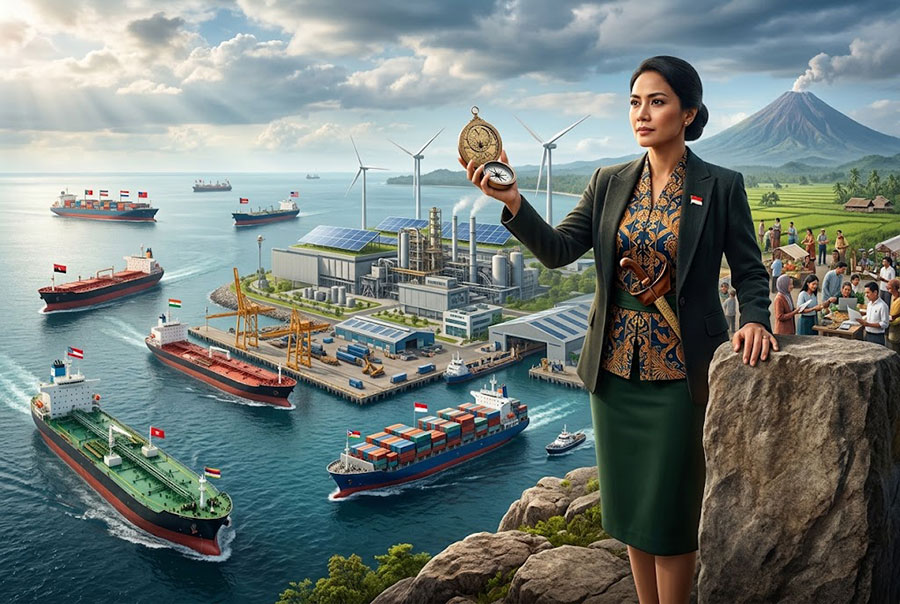
Indonesia is more than an archipelagic nation situated between two continents and two oceans. It occupies a strategic space that provides access to various parts of the world. Its geographical position, connecting the Indian Ocean and the Pacific Ocean, makes the Indonesian archipelago one of the key hubs for the movement of global trade, energy, investment, technology, and geopolitical interests.
Through the Indonesian Archipelagic Sea Lanes (Alur Laut Kepulauan Indonesia, or ALKI), international shipping routes traverse Indonesia’s maritime domain on their way to major economic centers around the world. This position is both a geographical blessing and a geopolitical responsibility. The more strategically positioned a country is, the greater the attention it attracts from the international community. Indonesia, therefore, must not view its geographical position merely as an economic advantage, but also as a source of strength and, at the same time, vulnerability that must be managed with strategic intelligence.
Indonesia’s global appeal is further strengthened by its abundant natural resources, which are essential to global development. Nickel, copper, bauxite, and various other strategic minerals have become critical components of modern industrial supply chains and the global energy transition. As the world moves toward electric vehicles, batteries, renewable energy, and low-carbon technologies, demand for these raw materials continues to grow significantly.
In this context, Indonesia’s natural resources are no longer merely trade commodities. They have become strategic assets in global economic and geopolitical competition. Therefore, global market interest in Indonesia must not result in the country becoming merely a marketplace for foreign products, a supplier of raw materials, or a production base where most of the added value is ultimately enjoyed abroad. Indonesia’s vast natural wealth will lose much of its strategic significance if the country serves only as a supplier of raw materials to industries in other nations.
Indonesia must move beyond being merely an owner of resources and become a key player in controlling the value chain. This is the true meaning of economic self-reliance: not closing the door to the world, but engaging with the world from a position of equality. At the same time, Indonesia’s geopolitics is not solely about oceans, minerals, investment, and markets. There is another source of strength that is both deeper and more sensitive: the Indonesian people.
Indonesia’s large population represents tremendous economic and demographic strength. However, a large population without quality, equitable development, and national unity can become a source of vulnerability. Indonesia is a nation built upon diversity in ethnicity, religion, race, language, customs, and culture. The Indonesian archipelago is also renowned for its fertile land and rich biodiversity, which enable the cultivation of a wide variety of agricultural commodities.
In an increasingly competitive world, threats to a nation do not always come in the form of military force. They may emerge through information warfare, disinformation, social media manipulation, economic pressure, infiltration of external interests, exploitation of identity divisions, and the shaping of public opinion in ways that gradually erode citizens’ trust in their own country. Under such circumstances, natural resources, trade routes, and national strategic assets may themselves become targets in competing geopolitical interests.
Safeguarding national unity, therefore, is not merely a social concern. It is an integral part of Indonesia’s geopolitical defense. Bhinneka Tunggal Ika, or Unity in Diversity, must consequently be positioned as one of the nation’s strategic strengths. Diversity must not be allowed to become an arena for competing narrow interests. The state must ensure that every citizen experiences justice, has access to relatively equal opportunities, and has compelling reasons to place trust in their own country.
The state must not allow itself to be easily dictated by external interests. At the same time, it must not use sovereignty as a justification for restricting criticism and democratic space.
True sovereignty must instead be built upon strong institutions, clean and accountable governance, a just legal system, a healthy democracy, and policies oriented toward the interests and welfare of the people.
It is within this context that Bung Karno’s TRISAKTI once again demonstrates its relevance. Political sovereignty, economic self-reliance, and cultural identity are not merely historical concepts. They constitute a strategic framework for navigating an ever-changing world. Political sovereignty means that Indonesia must be capable of determining its own policy direction based on its national interests.
Economic self-reliance means that Indonesia must have the capacity to process and add value to its natural resources, develop its industries, strengthen food and energy security, master technology, and build high-quality human capital without becoming trapped in dependency. Cultural identity, meanwhile, means that Indonesia must be capable of embracing global influences without losing its national identity and character.
These three principles must advance together because political sovereignty without economic independence will remain fragile. Likewise, economic independence without a strong cultural identity risks losing its direction. Therefore, TRISAKTI should serve as the guiding spirit in implementing ASTA CITA toward the realization of Indonesia Raya. ASTA CITA should not merely be understood as a list of government development priorities. It must be positioned as a comprehensive strategy for building Indonesia’s national strength.
The world may need Indonesia’s resources, its market, its maritime routes, and its strategic geographical position. However, such global demand must never turn Indonesia into an object in a contest for influence. Indonesia must remain a sovereign actor with strong bargaining power. International cooperation must be built upon the principles of equality, mutual benefit, respect for sovereignty, and the protection of national interests.
Indonesia must therefore remain vigilant in safeguarding the sovereignty of the Unitary State of the Republic of Indonesia (Negara Kesatuan Republik Indonesia, or NKRI). Vigilance does not mean viewing the world with suspicion. Rather, it means recognizing that every nation has its own interests. Indonesia must remain open, but not naive; cooperative, but not dependent; friendly, but firm in defending its national interests. All of Indonesia’s geopolitical strengths, including its seas, natural resources, market, population, land, culture, and geographical position, must be managed as an integrated national strategy.
Indonesia must also become a nation capable of transforming its strategic position into sovereignty, its natural wealth into prosperity, its diversity into unity, and its openness into strength. TRISAKTI provides the compass, ASTA CITA provides the direction, and Pancasila provides the soul. From these foundations, Indonesia Raya must be built: an Indonesia that remains open to the world while standing firmly as a sovereign nation.
Ermaya Suradinata. He served as Director General for Social and Political Affairs at the Ministry of Home Affairs (1998–2001) and as Governor of the National Resilience Institute of the Republic of Indonesia (LEMHANNAS RI) (2001–2005).
 English
  Indonesian