
Pancasila and the Spirit of the Youth Pledge: Strengthening the Unitary State of the Republic of Indonesia Toward a Greater Indonesia
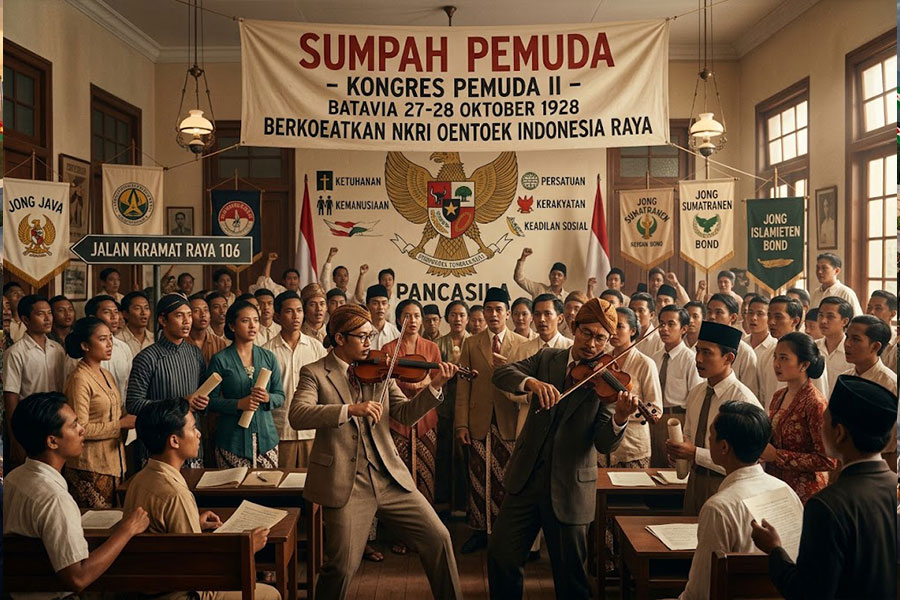
The Youth Pledge (Sumpah Pemuda) is not merely a historical event commemorated every October 28, but a revolution in national consciousness that transformed the way the people of the Indonesian archipelago perceived themselves as a nation. Long before Indonesia had its own state, government, and constitution, its young people had already envisioned a shared national home called INDONESIA.
They understood that independence could not be achieved by a society that remained confined within divisions of origin, language, and regional identity. Unity had to be established before sovereignty could be secured. This is the most fundamental legacy of the Youth Pledge, whose relevance has become even more urgent amid today’s geopolitical changes and national challenges.
This historic moment reached its culmination at the Second Youth Congress, held on October 27–28, 1928, in Batavia. Initiated by the Indonesian Students Association (Perhimpunan Pelajar-Pelajar Indonesia, PPPI), the congress brought together various youth organizations, including Jong Java, Jong Sumatranen Bond, Jong Bataks Bond, Jong Islamieten Bond, Jong Celebes, Jong Ambon, Pemuda Kaum Betawi, and Sekar Rukun.
At the closing session of the congress, held at the Indonesische Clubgebouw building on Jalan Kramat Raya 106, Wage Rudolf Supratman performed the song Indonesia Raya on his violin. The occasion generated an emotional and political resonance that extended far beyond the meeting hall. The pledge to acknowledge one homeland, Indonesia; one nation, the Indonesian nation; and to uphold Indonesian as the language of unity became a courageous declaration of commitment to building a collective identity.
From a historical perspective, the Youth Pledge demonstrates that Indonesia was first born as a moral consensus before becoming a political reality. This national consciousness later found its philosophical expression in Pancasila, introduced by Ir. Soekarno in his speech on June 1, 1945. If the Youth Pledge answered the question of who we are as a nation, Pancasila provided guidance on how we should live together as one nation. Both are historically and philosophically inseparable in the formation of Indonesia.
Pancasila provides ethical depth to the spirit of unity championed by the generation of 1928. Belief in One Almighty God affirms that national life requires a moral foundation. Humanity reminds us that independence must respect the dignity of every individual. National Unity serves as the bond that holds diversity together, while Democracy guided by deliberation establishes a means of managing differences. Social Justice ensures that independence does not end merely with a transfer of political power but brings prosperity to all citizens.
Thus, unity is not an end in itself, but a prerequisite for building a civilized and just national life. Nearly a century after the Youth Pledge, Indonesia faces a national paradox worthy of reflection. Technological advancement has enabled Indonesians to connect beyond geographical boundaries, yet digital connectivity does not always lead to greater social maturity.
Public discourse is frequently dominated by polarization, hate speech, disinformation, and identity-based conflicts. Differences in political views can easily turn into hostility, while freedom of expression often loses its sense of moral responsibility. Communication has become easier, but this does not necessarily mean that we have become better at understanding one another.
This is precisely why the Youth Pledge must be revisited as a critical reflection on the nation’s present condition. Despite limited communication facilities and the pressures of colonial rule, the generation of 1928 succeeded in establishing a profound consensus about a shared future. The greatest challenge facing Indonesia’s younger generation today is not merely how to achieve individual excellence, but how to connect personal achievements with the collective interests of the nation.
As Indonesia moves toward the vision of Golden Indonesia 2045 (Indonesia Emas 2045), this challenge becomes increasingly strategic. The centenary of independence must serve as an opportunity to demonstrate Indonesia’s ability to transform its demographic potential, natural resources, cultural richness, and geopolitical position into sovereign national strength. Young people must not be regarded merely as beneficiaries of development. They must become the principal drivers of economic transformation, scientific advancement, technological innovation, democratic consolidation, and environmental protection.
Therefore, bringing the values of the Youth Pledge and Pancasila into everyday life requires more substantive measures than annual commemorative ceremonies. Historical literacy must be integrated with digital literacy. Pancasila education must be brought to life through practical experiences of gotong royong (mutual cooperation), tolerance, deliberation, and social responsibility.
We must also recognize that nationalism in the twenty-first century does not mean isolating ourselves from the world. Mature nationalism enables Indonesia to participate confidently in international affairs without losing its national identity. The principles of an independent and active foreign policy, national sovereignty, and humanitarian solidarity must guide the younger generation in responding to geopolitical competition, developments in artificial intelligence, climate change, and shifts in global economic power.
The Youth Pledge teaches us that a nation’s greatness is not determined by uniformity, but by the willingness of its diverse communities to work toward shared goals. Pancasila provides the moral direction needed to ensure that these goals remain grounded in humanity and justice. These two historical legacies represent moral strengths that must be continually renewed through the concrete actions of every generation.
As Indonesia approaches the centenary of the Youth Pledge in 2028 and the centenary of its independence in 2045, the fundamental question is no longer simply whether young people know their nation’s history, but whether they possess the courage to continue the aspirations of their predecessors. The youth of 1928 bequeathed Indonesia as a national promise. Today’s generation bears the responsibility of transforming that promise into a social, political, economic, and cultural reality.
The Unitary State of the Republic of Indonesia (Negara Kesatuan Republik Indonesia, NKRI) will not become great merely because it possesses a glorious history. Indonesia will achieve greatness when every generation is capable of renewing the spirit of unity, preserving diversity, and striving for justice for all its people.
The Youth Pledge represents the courage to become one nation. Pancasila represents the wisdom to live together as one nation. Golden Indonesia 2045 must demonstrate that these two legacies are not merely historical memories, but remain alive as the spirit and guiding direction of Indonesia’s future.
Prof. Dr. Drs. Ermaya Suradinata, S.H., M.H., M.S. Geopolitical and Geostrategic Observer Director General of Social and Political Affairs, Ministry of Home Affairs of the Republic of Indonesia (1998–2001) Governor of the National Resilience Institute of the Republic of Indonesia (LEMHANNAS RI) (2001–2005)
 English
 Indonesian