Indonesia Safeguarding Global Geopolitical Stability in the Era of President Prabowo
Amid an increasingly uncertain world, stability is no longer merely a condition, but a conscious choice that must be pursued with firmness of vision and precision of strategy. Today’s global landscape is marked by fragmented interests, rivalry among major powers, energy crises, supply chain disruptions, and geopolitical tensions that spread from one region to another.
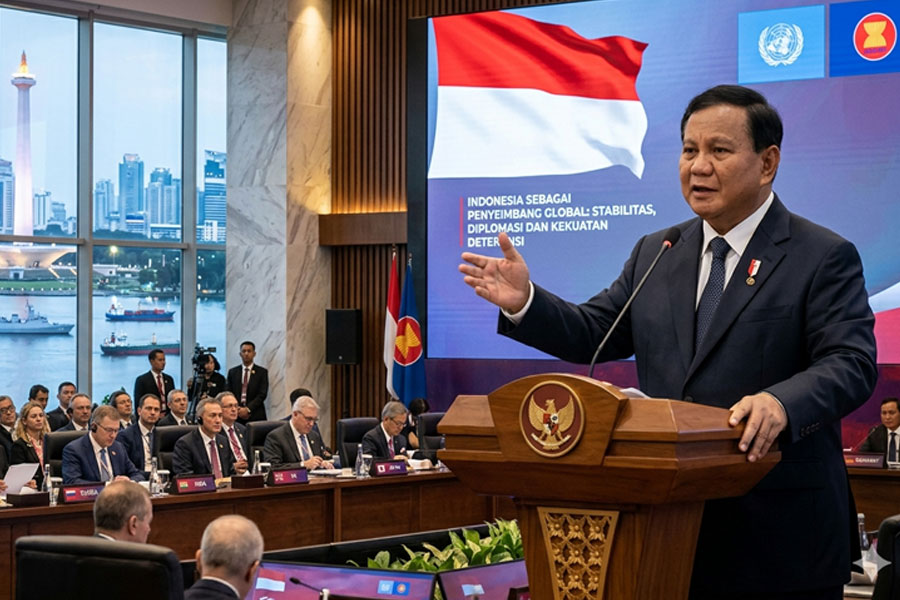
In such an environment filled with uncertainty, Indonesia cannot afford to remain a passive observer. It is called upon to act as a balancer—a moderate force capable of maintaining the rhythm of stability while carefully articulating its national interests. Under the leadership of Prabowo Subianto, efforts to maintain global stability are gaining momentum through a firmer approach that remains rooted in Indonesia’s long-standing “free and active” foreign policy principle.
For Indonesia, global stability is not merely an external issue detached from domestic realities. It has direct implications for economic resilience, national security, and public welfare. When conflicts in one region disrupt international trade routes, Indonesia feels the impact through inflation, rising energy prices, and logistical disruptions.
In this context, maintaining global stability is essentially an effort to safeguard national stability itself. This awareness drives Indonesia to move beyond reactive responses toward a more proactive stance in addressing global dynamics. In President Prabowo’s era, the approach to global stability increasingly emphasizes a balance between strength and diplomacy. The world today values not only peaceful rhetoric, but also the real capacity of a nation to defend its interests.
This strengthening is not intended as an expression of aggression, but as an instrument of deterrence—a signal that Indonesia is prepared to safeguard its sovereignty without being drawn into open conflict. Within this framework, stability is built not through dominance, but through carefully maintained balance.
At the same time, diplomacy remains the core of Indonesia’s role on the global stage. Indonesia’s long-standing tradition as a bridge for dialogue among nations, particularly among opposing powers, serves as an invaluable asset. In an increasingly polarized world, the ability to engage all parties without losing independence becomes a strategic advantage. Indonesia strives to maintain this position—avoiding alignment with any particular power bloc, while remaining active in promoting conflict resolution through dialogue and multilateral cooperation. It is here that the “free and active” principle finds its most concrete relevance—not as a historical slogan, but as an adaptive contemporary strategy.
Global stability is also closely linked to Indonesia’s role within the regional architecture, particularly in Southeast Asia. ASEAN, as a shared home, bears the responsibility of ensuring that the region remains peaceful, stable, and prosperous. In this context, Indonesia plays a key role as a driving force. It is therefore expected to maintain ASEAN’s internal cohesion while ensuring that the region does not become an arena for competing interests that could undermine stability.
Maintaining global stability cannot rely solely on external approaches. Its foundation lies in domestic strength. A nation can only play an effective role globally if it possesses solid internal stability. Economic consolidation, institutional strengthening, and human resource development are essential prerequisites. Indonesia must also ensure that its economic growth is inclusive and sustainable, enabling it to withstand external shocks. At the same time, good governance will enhance Indonesia’s credibility in the eyes of the world, strengthening its position as a trusted partner.
Despite these efforts, challenges remain inevitable. An increasingly complex world demands high adaptability. Policies that are effective today may not be relevant tomorrow. Therefore, flexibility becomes key. Indonesia must continuously read the direction of global change, anticipate potential crises, and respond with appropriate policies.
In this regard, leadership plays a crucial role. A leader is not only required to understand existing realities, but also to envision the future and guide the nation toward it. The era of President Prabowo opens space for a more pragmatic approach without abandoning idealism.
On one hand, Indonesia remains committed to the values of peace, cooperation, and global justice. On the other hand, it does not hesitate to strengthen its position through various instruments of national power. This approach reflects an awareness that the world does not always operate according to expected norms. In certain situations, national interests must be safeguarded with firmness.
It is within this context that Indonesia’s role becomes increasingly relevant. As a nation born from diversity, Indonesia has historical experience in managing differences. This experience serves as both moral and political capital that can be brought to the global stage.
Thus, in the era of President Prabowo’s leadership, Indonesia’s efforts to maintain global stability are not merely a policy agenda, but also a reflection of its national identity—a nation that not only looks after its own interests, but also contributes to a more peaceful and balanced world. This role becomes increasingly important, while also serving as a test of Indonesia’s ability to remain steadfast and vigilant amid an often unpredictable global environment.
Prof. Dr. Drs. Ermaya Suradinata, SH, MH, MS
is an observer of geopolitics, geostrategy, and governance management.
 English
  Indonesian