Geopolitik Bergolak, Energi Terguncang: Ujian Strategis Indonesia
The world today seems to have lost its point of balance. A geopolitical landscape that was once relatively readable has transformed into a fluid space—moving without certainty and filled with tensions that resist being framed within a single narrative.
The conflict involving United States and Iran is merely one node in a broader web of crises, where energy, military, and political interests are deeply intertwined. Ceasefires, which should serve as gateways to peace, often turn into brief pauses—like a breath drawn before the next wave of conflict arrives.
The world is gradually shifting into a new phase of uncertainty, where the line between peace and war becomes increasingly thin and blurred. This uncertainty arises not only from the sound of weapons or forceful political statements, but also from latent tensions embedded in relations between states.
The polarization of global powers, increasingly open rivalries, and the presence of non-state actors further complicate the face of contemporary geopolitics. Stability, in this context, is no longer a condition that can be assumed, but rather an exception that is becoming increasingly rare.
The world now moves in a speculative rhythm, where a single decision in one capital can trigger ripples felt across distant regions. Within this broader current, energy emerges not merely as an economic variable, but as a political and strategic one.
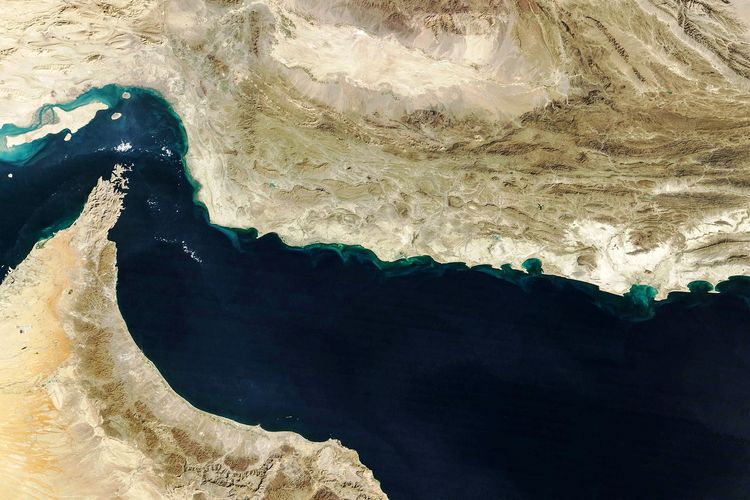
Disruptions in vital routes such as the Strait of Hormuz demonstrate how a single geographic point can influence global balance. When energy flows are disrupted, it is not only markets that waver, but also trust between nations.
Sharp fluctuations in oil prices reflect global anxiety, while also signaling that uncertainty has penetrated the very foundations of the global economy.
Amid these dynamics, Indonesia does not exist in a vacuum. As part of the international system, it feels the tremors of every shift that occurs. Dependence on global energy, economic interconnectedness, and its strategic position within global trade routes place Indonesia not merely as a spectator, but as a party that is affected—and potentially capable of playing a role.
Instruments of Global Power
In contemporary geopolitical dynamics, energy can no longer be understood merely as an economic necessity; it has evolved into an instrument of power that shapes the direction of relations between states.
Energy distribution routes such as the Strait of Hormuz have become critical nodes in maintaining—or even disrupting—global stability. Approximately 20 percent of the world’s oil supply passes through this narrow passage, making it not only the lifeline of the international economy but also a strategic pressure point in every escalation of conflict.
When access to this route is disrupted, the impact does not stop at rising energy prices; it spreads as a systemic disruption that affects the entire architecture of the global economy.
The surge in oil prices approaching 100 US dollars per barrel reflects just how fragile this balance is. An increase of 3–6 percent within just a few days indicates that energy markets do not merely respond to actual events, but also to risk perceptions shaped by geopolitical dynamics.
In such conditions, uncertainty becomes an invisible yet highly influential commodity. Every speculation can move the market with an intensity comparable to realities on the ground.
The relationship between energy-producing and energy-consuming countries has also evolved into a complex and ambiguous one. On one hand, there is mutual dependence, as energy needs transcend sovereign boundaries. On the other hand, persistent suspicion arises, as energy is used both as a bargaining tool in diplomacy and as leverage in conflict.
In this context, energy speaks the language of power—not always loudly, but always with impact.
Within such a global landscape, energy no longer sits at the margins of geopolitics; it lies at its very center. It serves as a medium that connects economic interests, military strategies, and political calculations in a single breath.
As the world moves through uncertainty, energy becomes both an indicator and a driver of change.
This is where it becomes clear that an energy crisis is not merely a matter of supply, but a reflection of a world renegotiating with itself—seeking a new balance amid increasingly complex and competing interests.
Energy Crisis and Its Global Economic Impact
An energy crisis never stands alone; it moves like a wave that reverberates from one sector to another, creating a domino effect that is difficult to contain.
Rising oil prices do not stop at figures on trading boards; they cascade into production costs, transportation expenses, and ultimately the prices of essential goods directly felt by society.
In several European countries, fuel prices reaching the range of IDR 40,000–43,000 per liter provide a tangible illustration of how geopolitical pressures translate into everyday burdens.
Governments are compelled to inject billions of dollars to maintain social and economic balance—an enduring reminder that global uncertainty always comes at a cost.
The ripple effects of this crisis extend into a more subtle domain: trust. In Germany, for instance, declining investor sentiment signals that the business community perceives the energy crisis not merely as a temporary disruption, but as a structural threat to economic stability.
When energy—as the foundation of production—becomes uncertain, investment decisions are inevitably clouded by doubt. Businesses are no longer calculating profits alone; they are also weighing risks that have become increasingly unpredictable.
The global economy operates within a paradoxical logic. This condition underscores that the energy crisis is a reflection of deepening global interconnectedness.
What occurs in one region—such as disruptions to vital global energy routes—can trigger economic reverberations across continents. No country is truly insulated from its effects, as the global economic system is woven into an interdependent network.
Within this network, even a minor shock can evolve into a major wave that affects stability on a broad scale.
Thus, in continuity with earlier geopolitical dynamics, the energy crisis reveals a world moving within an increasingly complex space of uncertainty. It is no longer merely a matter of supply and demand, but part of an ever-shifting configuration of global power.
Energy has become the meeting point between economics and politics; consequently, every disruption can no longer be viewed in isolation.
The world is learning to confront a reality in which stability is not a given condition, but something that must be continuously pursued.
Challenges and Vulnerabilities of National Energy
As a developing country with continuously growing energy needs, Indonesia finds itself in a position that is far from secure amid global turbulence. Dependence on oil imports means that any fluctuation in global energy prices is immediately felt domestically.
Rising oil prices do not only affect energy costs; they also place pressure on fiscal stability through increasing subsidy burdens. Energy, therefore, is no longer merely a technical matter—it has evolved into a strategic issue that shapes the direction of national development and economic resilience.
This pressure highlights that global interconnectedness carries complex consequences. When energy prices surge due to geopolitical tensions in other regions, Indonesia has limited room to shield itself. The impact spreads across multiple sectors—transportation, industry, and even household purchasing power.
Such conditions position energy policy as one of the most crucial instruments in maintaining national stability, demanding responses that are not merely reactive, but measured and long-term in nature.
Yet behind this vulnerability lies an important space for reflection that should not be overlooked. The global energy crisis, in fact, presents an opportunity for Indonesia to accelerate its transformation toward energy independence.
The development of renewable energy—from geothermal and solar to wind—is no longer just an alternative option, but a strategic necessity. Energy efficiency and resource diversification are essential steps to reduce dependence on fossil fuels that are highly vulnerable to external shocks.
Energy resilience must therefore be understood within a broader framework. It is not only about the availability of supply, but also about a nation’s ability to manage global risks and adapt to change.
In an uncertain geopolitical landscape, energy resilience means having policy flexibility, strong institutions, and a long-term vision capable of anticipating the direction of global shifts. Indonesia is challenged not only to endure, but to build a solid foundation for its future energy system.
In continuity with earlier global dynamics, Indonesia’s position reflects how energy crises and geopolitics are intertwined within a larger current. Dependence can be a weakness, but it can also be transformed into a catalyst for change.
In a world marked by constant volatility, the ability to manage vulnerability becomes the key to building strength.
This is where both the challenge and the opportunity lie—transforming crisis from a mere threat into a starting point for a more sovereign and sustainable future.
Indonesia’s Geopolitics: A Global Reality
In navigating the currents of global geopolitics, Indonesia possesses a vital asset in its “free and active” foreign policy principle. This principle enables Indonesia to avoid being drawn into the rivalries of major powers, while still playing a role in maintaining balance and promoting world peace. Amid global conflicts and the pressures of the energy crisis, this position becomes increasingly relevant.
Indonesia is not merely an observer; it also holds the potential to serve as a bridge for dialogue—connecting opposing interests without losing sight of its national priorities.
In an increasingly polarized global landscape, a “free and active” stance is not passive neutrality, but an active strategy that requires careful reading of evolving circumstances. As the world is divided by competing energy, military, and economic interests, the ability to maintain balance becomes a distinct strength. Indonesia can play the role of a mediator, leveraging its moral and historical legitimacy in international diplomacy to ease tensions, while also advocating for stability that directly supports its domestic interests.
The growing complexity of the world demands more than principles alone. The fragmentation of global geopolitics requires Indonesia to be more adaptive and forward-looking in formulating its foreign policy. Active participation in international forums, strengthening economic diplomacy, and enhancing national capacity are essential foundations for navigating uncertainty.
In the context of the energy crisis, diplomacy is no longer confined to political relations; it also encompasses securing supply chains, diversifying energy sources, and fostering strategic cross-regional cooperation.
These challenges become more pronounced as global interests increasingly intersect with domestic pressures. National stability cannot be separated from international dynamics, making it imperative for foreign policy to move in tandem with efforts to strengthen internal resilience. In this regard, the ability to manage external relations while reinforcing internal foundations is key for Indonesia not only to endure, but also to enhance its bargaining power in the global arena.
In continuity with the evolving dynamics of geopolitics and the energy crisis, Indonesia faces choices that will shape its future trajectory. Global uncertainty is not merely a threat, but also an opportunity to build a more strategic role.
A nation that can interpret change, formulate wise responses, and maintain balance between national interests and global responsibilities will hold a stronger position. In an era of constant transformation, the ability to adapt and act with vision determines whether a nation merely follows change—or helps shape it.
Prof. Dr. Drs. Ermaya Suradinata, SH, MH, MS
is an observer of geopolitics, geostrategy, and public governance.
 English
  Indonesian