Developing Generation Z Officers for a Strong Indonesian National Armed Forces (TNI)
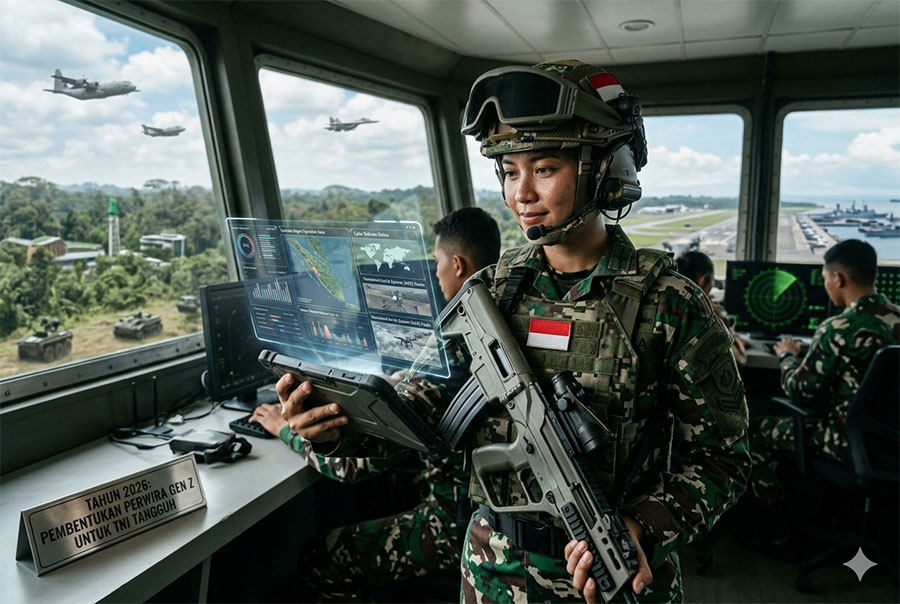
In an increasingly fluid and uncertain global geopolitical landscape, a nation’s military strength is no longer determined solely by the number of troops or the sophistication of its defense equipment, but by the quality of the people who operate it. The year 2026 marks a new phase in the evolution of warfare, where technological dominance—from artificial intelligence and unmanned systems to cyber warfare—has fundamentally shifted traditional paradigms of combat power.
Therefore, improving the quality of military education has become critically important, particularly in shaping the performance of junior TNI officers from Generation Z, who are now beginning to occupy tactical command positions across various units. Generation Z possesses characteristics that differ significantly from previous generations. They are products of a fast-paced, open, and information-driven digital era. Their ability to access, process, and utilize technology represents a strategic advantage that earlier generations did not possess on the same scale.
However, these strengths do not automatically translate into readiness for the complexities of the modern battlefield. This is where military education plays a central role as an instrument of transformation—not only transferring knowledge but also shaping ways of thinking, patterns of action, and leadership integrity. Strategies for enhancing military education must begin with the realization that an officer’s performance can no longer be measured solely by physical agility or obedience to command.
Today, performance encompasses situational analysis, rapid data-driven decision-making, and the ability to integrate diverse technological systems into military operations. Consequently, military education curricula must be designed using a more adaptive and multidisciplinary approach. Learning can no longer be linear and one-directional; instead, it must encourage interaction, simulation, and scenario-based problem-solving that reflects the realities of modern warfare.
Within this framework, the integration of technology into the educational process is no longer optional—it is essential. The use of combat simulators, virtual reality, and computer-based command games should not merely complement instruction but serve as core components of the learning methodology. Through these approaches, young officers can be trained to respond to a wide range of situations without having to wait for real-world battlefield experience.
This approach also aligns with the characteristics of Generation Z, who tend to respond more effectively to visual, interactive, and experiential learning methods. When educational approaches are aligned with learners’ characteristics, educational effectiveness increases significantly. Nevertheless, strategies to improve educational quality cannot focus solely on technology. Leadership remains a determining factor in shaping the performance of junior officers.
Generation Z requires leadership approaches that are not only command-oriented but also inspirational and communicative. They are generally more receptive to guidance that is accompanied by rational explanations and genuine role models. Therefore, military education systems must instill adaptive leadership models that combine firmness with empathy and discipline with the ability to build trust.
Young officers must be educated not only to lead troops but also to understand the psychological dynamics of their personnel, particularly under conditions of high pressure. In terms of performance, technological literacy has become an indispensable variable. Junior TNI officers from Generation Z must possess a strong understanding of modern weapons systems, including aerospace capabilities, cyber defense, and data-driven intelligence. Such competencies not only improve operational effectiveness but also provide advantages in confronting increasingly complex asymmetric threats.
Military education must equip officers with the ability to read and interpret data, understand patterns of threats, and formulate appropriate responses within limited timeframes. Strategies to improve military education quality must also emphasize cross-sector collaboration. In the modern era, technological innovation is no longer confined to the military domain; it is advancing rapidly within civilian sectors, particularly universities and technology industries. Consequently, synergy between the TNI, educational institutions, and the national defense industry represents a strategic step toward enriching learning content and accelerating technology transfer.
Amid this drive toward modernization, character development must remain the primary foundation and should never be overlooked. High performance without integrity can become a threat to the organization itself. Therefore, the values of Pancasila, the Sapta Marga, and the Soldier’s Oath must continue to be internalized throughout every stage of military education. Generation Z, raised amid globalization, requires a strong sense of national identity to remain grounded when confronted with various external influences.
Military education must serve as a character-building environment that instills loyalty, responsibility, and dedication to the nation. Strategies for enhancing military education have direct implications for the TNI’s readiness to confront future challenges. Well-educated junior officers will become the spearhead of defense policy implementation and agents of change in the organization’s transformation process.
Thus, improving the quality of military education is not merely an institutional necessity but an integral part of a national strategy to safeguard state sovereignty. Generation Z, with all its potential and challenges, must be placed within the proper developmental framework to enable them to grow into officers who are not only technically proficient but also intellectually mature and morally resilient.
In an increasingly complex world, the true strength of a nation lies in the quality of its people. In the context of national defense, that quality is shaped, nurtured, and tested through military education that is visionary, adaptive, and firmly rooted in national values.
Prof. Dr. Drs. Ermaya Suradinata, SH, MH, MS
Observer of Geopolitics, Geostrategy, and Public Administration.
 English
  Indonesian