
Police Demilitarization and the Courage to Reshape Democracy
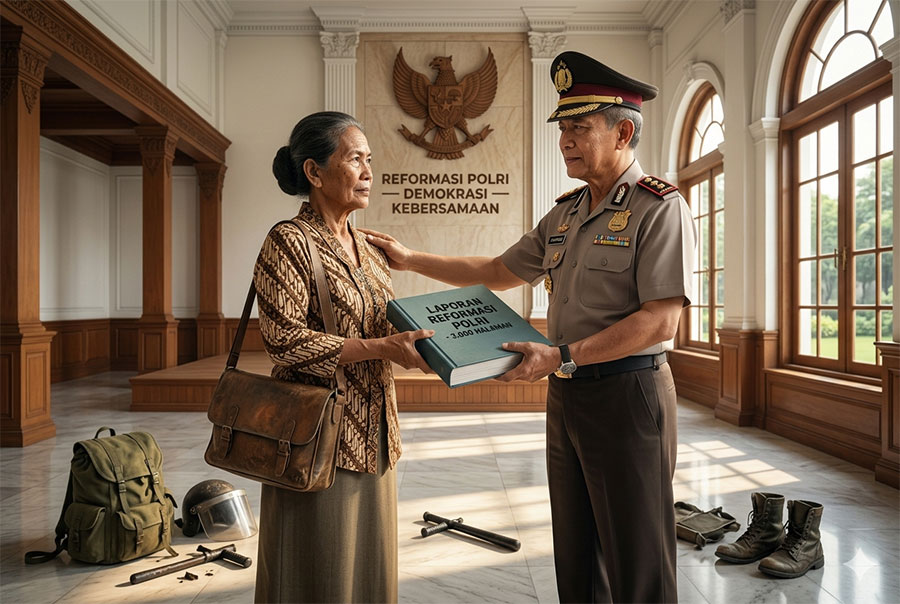
There are moments when a nation reflects upon itself—not through grand speeches or state ceremonies filled with symbolism, but through the quiet acknowledgment that something can no longer be maintained as it is. The submission of the 3,000-page report of the Commission for the Acceleration of Reform of the Indonesian National Police to President Prabowo Subianto is precisely such a moment.
This was not merely the handover of a bureaucratic document. Rather, it signified that the state has finally reached a point of realization: the challenges facing the police are no longer minor cracks that can be patched with administrative fixes, but fundamental issues concerning the relationship between power, law, and democracy. Three thousand pages is far too substantial a volume to merely explain technical mistakes.
Indonesia is not a nation lacking in ideas. Since the Reformasi era of 1998, numerous teams, commissions, and evaluation bodies have been established to address various national challenges. We are skilled at diagnosing problems, meticulous in identifying issues, and eloquent in formulating recommendations. Yet all too often, we stop just before meaningful transformation truly begins. It is as if the nation is willing to acknowledge its wounds but not necessarily prepared to undergo surgery.
This is why the recommendation to demilitarize the National Police is significant not only from a technical perspective but also from a philosophical one. Police and military institutions are born from fundamentally different purposes. The military is designed to confront threats of war, whereas the police exist to serve and protect civilian society. When military approaches become too dominant within policing institutions, the relationship between officers and citizens gradually changes. Society is no longer viewed as a subject to be protected but as an object to be controlled.
Demilitarization is, in essence, an effort to restore policing to its original purpose: serving humanity. A humane police force is not a weak police force; rather, it understands that the greatest strength of the state lies not in the fear it creates, but in the trust it builds. Fear may produce temporary compliance, but trust generates lasting legitimacy.
This agenda carries profound historical significance. The Reform Movement of 1998 was fundamentally a long struggle to separate political power from excessive dominance over the civic sphere. Indonesia experienced a period when criticism was regarded as a threat and security was understood merely as the preservation of political stability. Therefore, police reform today is not a new agenda but part of Indonesia’s unfinished democratic journey.
The greatest challenge of reform has never been conceptualization; it has always been implementation. Oversight of the police institution, for example, remains trapped in administrative formalities. Internal supervision has limitations because it operates within the same circle of interests, while external oversight mechanisms have yet to acquire sufficient authority to provide effective correction. As a result, the public frequently witnesses a troubling irony: violations are acknowledged, but accountability proceeds slowly—or disappears altogether within bureaucratic processes.
This is why strengthening the National Police Commission (Kompolnas) and other independent oversight mechanisms is so important. Institutions entrusted with the lawful use of force must also be the most transparent. The police possess the authority to arrest, detain, and, in certain circumstances, use weapons. Such powers represent an enormous mandate within a democratic state. Every significant mandate must be accompanied by equally significant accountability.
The police, therefore, must be designed as an instrument of the state, not an instrument of political power. When law becomes too closely intertwined with politics, citizens find it difficult to distinguish between the pursuit of justice and the pursuit of political interests. At that point, public trust begins to erode. In truth, Indonesians do not demand impossible perfection. They simply wish to experience a legal system that operates fairly, humanely, and without the perception that it is harsh toward the weak yet lenient toward the powerful.
Public trust is built through everyday experiences: through the way people are treated when seeking justice, through how authorities respond to criticism, and through the extent to which the state demonstrates its commitment to protecting the rights of ordinary citizens. State legitimacy is not created through grand slogans. It emerges from consistency in action. A rule-of-law state exists not merely because of legislation, but because people believe that the law genuinely works for everyone.
For this reason, the 3,000-page reform report may be only the beginning. It is a map, not the journey itself. It points the way forward, but it does not automatically move the nation. Ultimately, everything depends on one thing that has always been rare in politics: courage.
The courage to limit excessive concentrations of power. The courage to accept stronger oversight. The courage to place the law above short-term interests. And the courage to recognize that a healthy democracy is built not through fear, but through trust.
The history of great nations consistently teaches the same lesson: strong institutions are not those immune to criticism, but those willing to reform themselves. Ultimately, police reform is not merely about the police. It is a reflection of Indonesia’s future direction. The fundamental question is whether this nation truly intends to build a mature and civilized rule-of-law state, or whether it will continue allowing power to grow beyond the limits that ought to be safeguarded.
By Prof. Dr. Drs. Ermaya Suradinata, SH, MH, MS
Observer of Geopolitics, Geostrategy, and Public Administration.
 English
  Indonesian