Pancasila Amid Global Geopolitical Uncertainty
The commemoration of Pancasila Day every June 1 is not merely a ceremonial occasion to remember the birth of Indonesia’s state ideology. It serves as an important reminder of how this nation was built upon a foundation of thought shaped by historical struggles, ideological debates, and the geopolitical awareness of the founding fathers in understanding the direction of global change.
This date refers to the session of the Investigating Committee for Preparatory Work for Indonesian Independence (BPUPKI) on June 1, 1945, when President Ir. Soekarno first introduced the concept of Pancasila as the foundation of the state. In his monumental speech, Bung Karno not only formulated the five principles as normative guidelines for national and state life, but also presented a grand vision regarding Indonesia’s position in a world filled with conflict, colonialism, and competition among nations.
From its inception, Pancasila was not born in a historical vacuum. It emerged amid a world shaken by World War II and intense ideological battles that shaped the course of human civilization. Therefore, understanding Pancasila is not merely about treating it as a symbol or a set of principles repeatedly recited in official speeches.
Pancasila is fundamentally both a philosophy of life and a national strategy designed to ensure that Indonesia remains steadfast amid the ever-changing dynamics of the times. The nation’s founders understood that political independence would not endure without an ideological foundation capable of uniting Indonesia’s diversity while providing direction in confronting international geopolitical pressures.
This awareness has given Pancasila an open, adaptive character that remains relevant across generations. In a constantly changing world, Pancasila has not lost its significance; rather, it continues to demonstrate its historical and strategic relevance.
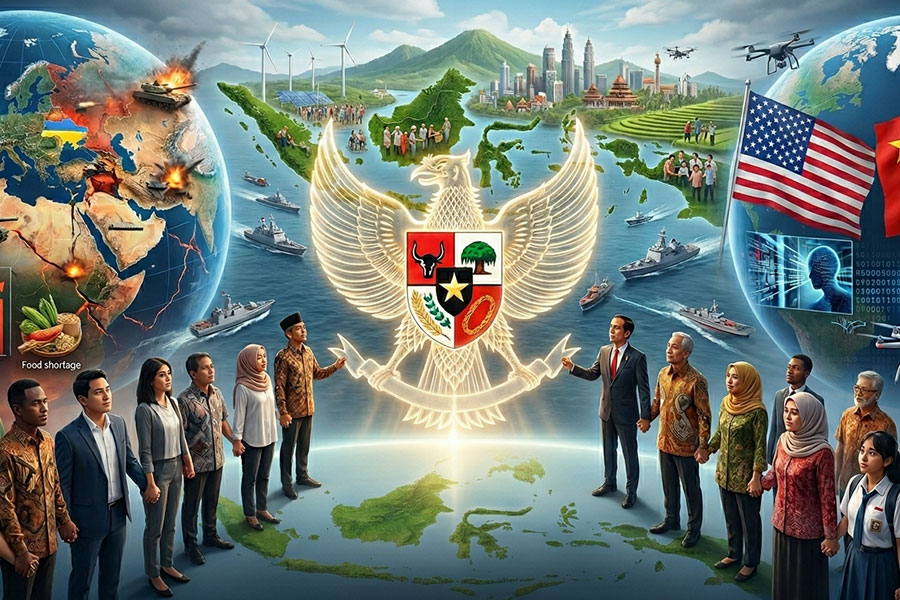
Today, the world once again faces an increasingly complex geopolitical landscape marked by uncertainty. The rivalry between the United States and China continues to influence stability in the Indo-Pacific region. The prolonged Russia–Ukraine war has triggered global energy, food, and economic crises. Meanwhile, conflicts in the Middle East have created new threats to international security and global market stability.
At the same time, advances in digital technology, artificial intelligence, cyber warfare, and competition for global economic influence have transformed interstate rivalry into a multidimensional contest. The world has entered an era in which conflicts are no longer confined to open military confrontations but are increasingly conducted through technological dominance, information control, strategic resource acquisition, and cultural and economic influence.
In such a global environment, Indonesia cannot afford to remain passive. Its strategic geographic position at the crossroads of the Indian and Pacific Oceans gives Indonesia immense significance in global geopolitical affairs. International trade routes, maritime interests, and great-power competition have made Southeast Asia a critical arena in the struggle for global influence.
Under these circumstances, Pancasila serves as a moral and ideological anchor that prevents Indonesia from being easily drawn into global polarization. Indonesia’s long-standing “free and active” foreign policy is, in fact, a practical manifestation of Pancasila’s values in international relations.
Simultaneously, globalization, digital cultural penetration, the spread of disinformation, and the rise of identity politics have posed serious threats to national social cohesion. In the digital sphere, people are often trapped in extreme polarization, hate speech, and opinion battles that erode the spirit of unity. The value of mutual cooperation is gradually being replaced by individualism. The spirit of deliberation is increasingly supplanted by a culture of hostility and confrontation. Ironically, despite technological advancement, humanity is experiencing a growing crisis of empathy and social solidarity.
This is why it is essential to recontextualize Pancasila—not merely as a slogan, but as a public ethic and national orientation in everyday life. Pancasila education should move beyond rote memorization and instead cultivate critical awareness of the contemporary challenges facing the nation.
Indonesia needs national leadership capable of translating Pancasila’s values into development strategies and public policies. National resilience in the modern geopolitical era cannot rely solely on military strength. It must also be built upon economic resilience, food security, energy security, technological capability, quality education, and social unity.
A strong nation is not simply one that possesses advanced weaponry. Rather, it is a nation whose people have confidence in their country. Therefore, strengthening national character, ensuring equitable development, and safeguarding national interests must remain strategic priorities for Indonesia amid rapid global transformation.
Pancasila also teaches that progress should never come at the cost of losing moral roots and cultural identity. Modernity without character will only produce fragile progress. Amid the powerful currents of global capitalism and increasingly fierce international competition, Indonesia requires a balance between material development and moral development.
The commemoration of Pancasila Day should serve as a moment of national reflection, reminding us that Indonesia’s greatest strength lies not merely in its natural resources, population size, or strategic geographic location, but in its ability to maintain unity amidst diversity and uphold national morality in an increasingly pragmatic world.
Pancasila is Indonesia’s great common home—a unifying force that embraces differences while serving as a compass for navigating change. As the world faces geopolitical fragmentation, humanitarian crises, and global uncertainty, Pancasila offers a vital message of balance, justice, solidarity, and peace.
The forms of global geopolitical challenges may change from one generation to the next, but the need for unity, justice, humanity, and wisdom will always remain the fundamental pillars of a nation’s survival. Indonesia stands in the midst of a world marked by rivalry and uncertainty. Yet, as long as Pancasila is preserved as the soul of the nation, Indonesia will continue to possess the capacity to endure, adapt, and move forward with dignity and independence.
Prof. Dr. Drs. Ermaya Suradinata, SH, MH, MS, is an observer of Geopolitics, Geostrategy, and Government Management.
 English
  Indonesian