Indonesia's Geopolitics Is Expected to Become More Stable
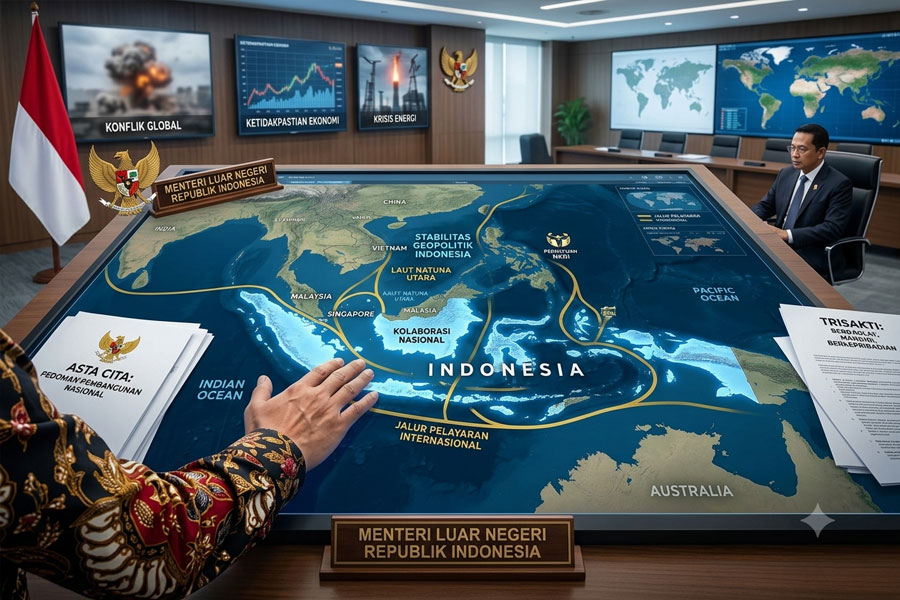
In an increasingly unpredictable world, stability is no longer merely a desirable condition—it has become a strategic necessity for every nation seeking not only to survive but also to prosper. Ongoing wars in various regions, intensifying rivalry among major powers in the Indo-Pacific, energy crises, growing cybersecurity threats, and global economic uncertainty have transformed the international geopolitical landscape into one that is far more complex than it was a decade ago.
In such circumstances, Indonesia stands at a critical crossroads. As the world’s largest archipelagic state, controlling vital international sea lanes and serving as the strategic bridge between the Indian and Pacific Oceans, Indonesia occupies an exceptionally important geopolitical position. This strategic location presents tremendous opportunities while simultaneously exposing the nation to significant risks.
Therefore, Indonesia’s greatest aspiration today is to achieve geopolitical stability that can ensure the continuity of national development while safeguarding the country’s interests amid an ever-changing global environment. Geopolitics is not merely about territorial boundaries or military strength; it is equally about a nation’s ability to manage all of its national resources in responding to the dynamics of the strategic environment.
Indonesia possesses substantial geopolitical assets, including its vast territory, large population, abundant natural resources, and strategic geographical position at the center of global maritime trade routes. However, these advantages can only be fully realized when supported by strong and sustainable political stability.
No country can achieve long-term economic development if it remains preoccupied with internal political conflict. Conversely, political stability creates legal certainty, strengthens investor confidence, expands diplomatic opportunities, and enhances the state’s capacity to address multidimensional threats originating from beyond its borders.
The aspiration for a stable Indonesian geopolitical environment is also inseparable from the importance of building national collaboration. Democracy naturally provides space for differing opinions and political competition, yet all of these dynamics should ultimately converge toward a common objective: preserving the unity and integrity of the Unitary State of the Republic of Indonesia (NKRI). Once the democratic process has produced a legitimate government, all political forces should place the national interest above partisan or group interests.
Collaboration among political parties constitutes essential political capital for addressing strategic national challenges, ranging from food security, economic transformation, and defense modernization to improving the quality of human resources. Political maturity is measured not by the intensity of political debate, but by the ability to build consensus for Indonesia’s future.
Indonesia’s history offers invaluable lessons about the importance of unity in confronting geopolitical challenges. The nation’s independence was not achieved through the efforts of a single group, but through the collective struggle of all elements of society united by a common aspiration for freedom. The Founding Fathers recognized that diversity was not a weakness but a source of strength when united by the spirit of nationalism.
History, therefore, should not merely be viewed as a record of the past. Rather, it should serve as a moral foundation for shaping the nation’s future. As the world undergoes rapid transformation, the values of unity, mutual cooperation (gotong royong), and nationalism inherited from Indonesia’s founders become even more relevant as guiding principles for safeguarding the continuity of the Republic.
At the same time, Indonesia requires a development path firmly rooted in its own national identity. Sukarno’s Trisakti doctrine remains a strategic framework for responding to contemporary geopolitical challenges. Political sovereignty means that Indonesia determines its national policies independently, without yielding to pressure from foreign powers. Economic self-reliance means building an economic structure capable of creating added value through industrialization, downstream processing of natural resources, technological innovation, and the strengthening of domestic industries, thereby reducing dependence on fluctuations in the global economy. Meanwhile, maintaining a strong cultural identity serves as the nation’s foremost defense against the powerful currents of globalization, which often erode national identity.
From a geopolitical perspective, the Indo-Pacific region will continue to command global attention as the principal arena of competition among major powers. The North Natuna Sea, international maritime trade routes, maritime security, and technological leadership will remain strategic issues that shape the region’s future. Indonesia cannot avoid these evolving dynamics.
Nevertheless, Indonesia possesses a significant opportunity to serve as a balancing power through its long-standing independent and active foreign policy. Indonesian diplomacy has consistently emphasized dialogue, cooperation, and the peaceful resolution of conflicts. This role should continue to be strengthened so that Indonesia becomes not merely an object of geopolitical competition but an influential actor capable of shaping regional and global stability.
The aspiration for Indonesia’s geopolitical stability also finds relevance in the implementation of the Asta Cita as the nation’s development agenda. Every major development priority—including strengthening food security, achieving energy self-sufficiency, improving educational quality, accelerating digital transformation, expanding infrastructure, reforming the bureaucracy, and enhancing national defense—depends upon sustained political and security stability.
Asta Cita requires policy continuity that is not easily disrupted by short-term political dynamics. Therefore, every component of the nation shares the responsibility of fostering a conducive political climate so that strategic development programs can generate tangible benefits for society. In this sense, political stability does not mean eliminating differences; rather, it means transforming diversity into a source of national strength.
By embracing history as its foundation, Trisakti as its strategic orientation, Pancasila as the philosophical basis of national life, and Asta Cita as the roadmap for national development, Indonesia possesses strong capital for confronting the geopolitical challenges of the twenty-first century. Ultimately, the aspiration for a stable geopolitical environment is not merely the hope of the government, but the shared aspiration of all Indonesians—to see their nation continue advancing as a country that is politically sovereign, economically self-reliant, culturally confident, and capable of making meaningful contributions to global peace and the advancement of human civilization.
Prof. Dr. Drs. Ermaya Suradinata, S.H., M.H., M.S.
Observer of Geopolitics, Geostrategy, and Government Management
 English
  Indonesian