Pancasila and Literacy: Two Pillars for Indonesia in Facing Global Uncertainty
The world is entering an era of profound uncertainty. Geopolitical conflicts across various regions, economic competition among nations, disruptions caused by artificial intelligence, climate change, and the growing information war in the digital sphere have created unprecedented challenges for every country. No nation is entirely immune to these changes.
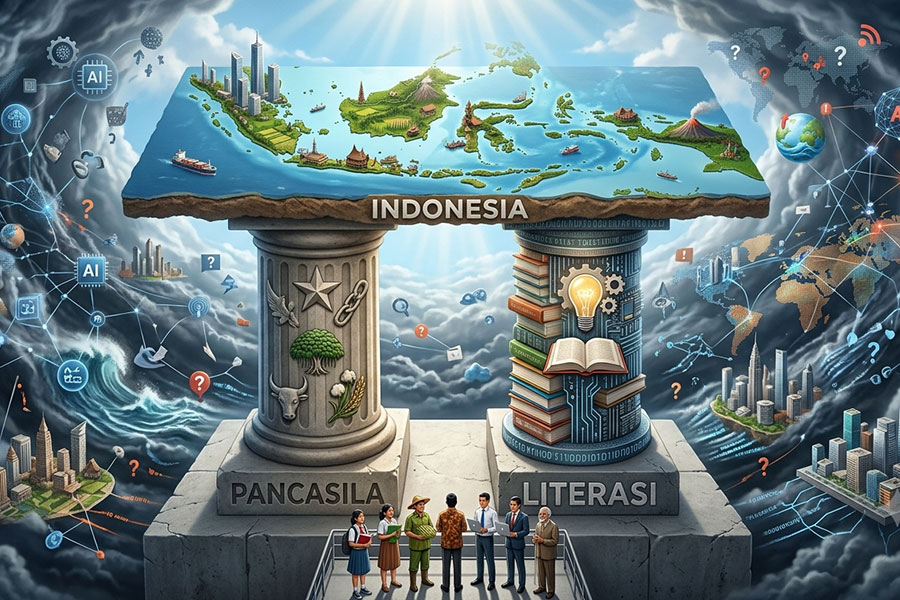
Even developed countries must continue adapting to avoid falling behind in an increasingly competitive global landscape. In such circumstances, Indonesia needs a strong foundation not only to survive but also to thrive amid rapid global transformation. That foundation consists of two essential pillars: a strong national ideology and advanced literacy.
For Indonesia, that ideology is Pancasila. Since the nation’s independence, Pancasila has served as the common ground that unites the diverse peoples of the archipelago. Amid differences in ethnicity, religion, language, culture, and political interests, Pancasila functions as the glue that binds the nation together. It is not merely the philosophical foundation enshrined in the Constitution, but a guiding worldview that directs Indonesia’s national journey.
The challenges of today’s era differ significantly from those faced during Indonesia’s early years of independence. Threats to national sovereignty no longer come solely in the form of colonialism or military aggression. Instead, they increasingly emerge through digital spaces, cultural infiltration, the spread of misinformation, radicalization, social polarization, and various forms of information manipulation that influence public perception and decision-making. In the age of social media, individuals may consume thousands of pieces of information every day without sufficient time to verify their accuracy. Consequently, society becomes increasingly vulnerable to disinformation capable of undermining national unity.
This is where literacy becomes indispensable. Literacy can no longer be understood simply as the ability to read and write. Modern literacy encompasses the capacity to comprehend information, think critically, analyze facts, distinguish between opinion and evidence, and make informed decisions based on reliable knowledge. It enables individuals to resist propaganda, manipulation, and false information circulating in the public sphere.
The relationship between Pancasila and literacy is therefore inseparable. Pancasila provides the moral direction and national purpose, while literacy equips citizens with the knowledge and critical thinking needed to realize those ideals. Without a strong ideological foundation, literacy risks becoming a purely technical skill without ethical direction. Conversely, without sufficient literacy, the values of Pancasila may remain little more than slogans that are difficult to translate into everyday practice. Together, they complement one another and cannot be separated.
In the context of national development, literacy is also a key driver of competitiveness. Today’s world is rapidly transitioning toward a knowledge-based economy. A nation’s strength is no longer determined solely by the size of its territory or the abundance of its natural resources, but by the quality of its human capital. Countries capable of generating innovation, technological advancement, and scientific knowledge will occupy stronger positions in the global arena.
Indonesia has a significant opportunity to emerge as one of the world’s leading powers by the middle of the twenty-first century. Its current demographic dividend represents a highly valuable strategic asset. Millions of young Indonesians will enter their productive years over the coming decades. However, this opportunity will only become a genuine advantage if supported by high-quality education and a strong culture of literacy. Without adequate literacy, the demographic dividend may instead become a burden that slows national development.
Literacy is also an essential component of national resilience. In modern security concepts, warfare is no longer fought exclusively with weapons. Many nations increasingly employ information warfare to influence public opinion in other countries. Misleading information can be used to erode public trust in state institutions, intensify social conflicts, and weaken national unity. Therefore, a society with high literacy serves as the first line of defense against these non-military threats.
At the same time, Pancasila functions as the nation’s moral compass. Technological and economic progress often brings complex social consequences. Artificial intelligence, digitalization, and automation undoubtedly create tremendous opportunities, yet they may also widen social inequalities if not managed wisely. Pancasila provides the ethical framework to ensure that progress does not come at the expense of humanity, justice, and national unity.
In other words, Pancasila ensures that development produces not only economic growth but also equitable prosperity. Building Indonesia’s future therefore requires far more than constructing physical infrastructure. Highways, ports, industrial zones, and advanced technologies are undoubtedly important, but investing in human development is even more critical.
A great nation is not defined merely by towering buildings or sophisticated technologies. It is defined by citizens who possess strong character, sound knowledge, and the ability to think critically. This is why education and literacy play such strategic roles. Indonesia’s younger generation must be equipped with the courage to think independently, the commitment to lifelong learning, and the character shaped by the values of Pancasila.
Ultimately, Indonesia’s future will be determined by the quality of its people. Pancasila and literacy therefore stand as two indispensable pillars in building that quality. Pancasila provides the vision and direction, while literacy provides the capability to achieve it. When the values of Pancasila are embodied by a literate society, Indonesia will cultivate citizens who are not only intellectually capable but also morally grounded and socially responsible.
Prof. Dr. Drs. Ermaya Suradinata, S.H., M.H., M.S.
Observer of Geopolitics, Geostrategy, and Government Management
 English
  Indonesian