
NAVIGATING GLOBAL GEOPOLITICAL TURMOIL: Strengthening the Resilience of Regional Government Governance
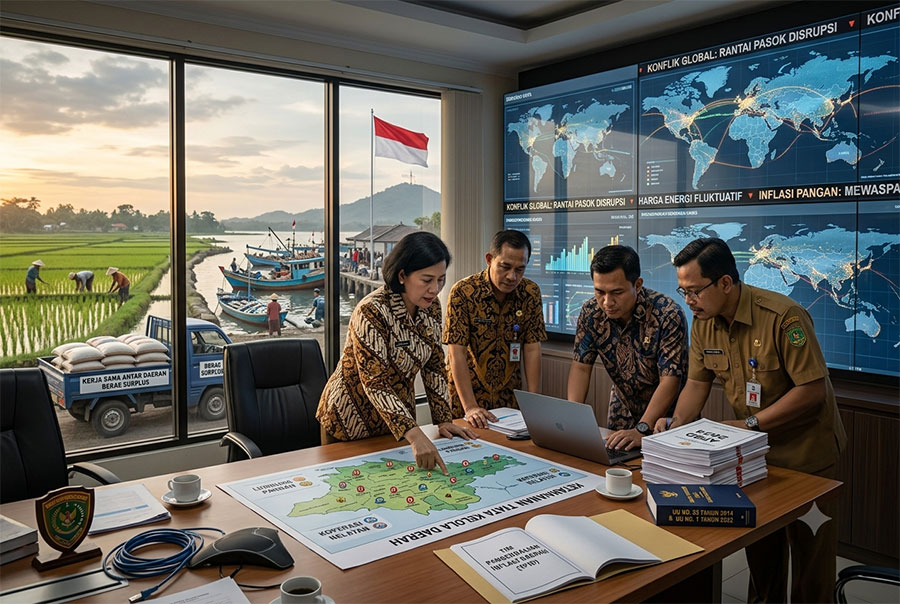
Global geopolitical turbulence is no longer an issue confined to diplomatic circles and negotiating tables between nations. International conflicts, trade wars, supply chain disruptions, fluctuations in energy prices, disruptions to shipping routes, and financial market uncertainty ultimately reach the level closest to people’s everyday lives: local communities and regions.
Under such conditions, Regional Governments (Pemerintah Daerah, or Pemda) are expected to serve not merely as administrative arms of government, but as the first line of defense in safeguarding the socio-economic resilience of their communities. Strengthening regional governance must therefore be positioned as an essential component of Indonesia’s NATIONAL RESILIENCE strategy in confronting global geopolitical uncertainty. This framework already has a strong legal foundation in Article 18 of the 1945 Constitution of the Republic of Indonesia and Law No. 23 of 2014 on Regional Government.
The law divides governmental affairs into absolute affairs under the authority of the Central Government, concurrent affairs shared between the Central and Regional Governments, and general governmental affairs. Concurrent affairs form the basis for the implementation of regional autonomy and encompass both mandatory and optional governmental responsibilities. In times of crisis, however, this division of authority must not remain merely a normative construct. It must be translated into tangible and effective governance capacity.
Regional heads, together with Regional People’s Representative Councils (DPRD), occupy a strategic position in ensuring that all regional government institutions operate in an integrated manner. Regional Secretariats must be capable of coordinating cross-sectoral policies. DPRD Secretariats must support the institutional functions of regional legislatures. Regional Inspectorates must strengthen oversight and prevent irregularities, while regional offices and agencies must operate according to their respective mandates and the needs of the public. Regional government institutions are not merely bureaucratic structures. They are instruments of the state at the local level.
In responding to crises, coordination among regional offices, agencies, subdistricts, urban villages, villages, and, where applicable based on regional characteristics, districts must be directed toward a single objective: ensuring the continuity of public services, the distribution of essential goods, and community economic activity. Law No. 23 of 2014 itself positions the DPRD and regional heads as constituent elements of regional governance, with distinct yet complementary functions.
One of the most immediate challenges is regional inflation. Rising energy and food prices can erode household purchasing power while simultaneously increasing production and distribution costs. Inflation control should therefore not be viewed merely as a technical economic matter, but as part of the responsibility of regional governments to maintain social stability. Regional Inflation Control Teams (Tim Pengendalian Inflasi Daerah, or TPID) must be fully utilized as cross-sectoral coordination forums, rather than becoming active only after prices have already surged.
Regional resilience also depends heavily on fiscal resilience. Under Law No. 1 of 2022 on Financial Relations between the Central Government and Regional Governments, regional revenue sources, the management of Transfers to Regions (Transfer ke Daerah, or TKD), regional expenditure, regional financing, and national fiscal policy synergy are integral components of central-regional financial relations. Regional governments must therefore strengthen their Own-Source Revenue (Pendapatan Asli Daerah, or PAD) in a sound and sustainable manner, without burdening communities with unproductive levies.
During periods of external pressure, the Regional Revenue and Expenditure Budget (Anggaran Pendapatan dan Belanja Daerah, or APBD) must function as an instrument for protecting communities, rather than merely as an annual administrative document. Ceremonial and less productive expenditures, particularly those with little direct impact on public services, should be reassessed. Available fiscal space should instead be directed toward social protection, food security, healthcare services, basic infrastructure, labor-intensive sectors, and programs that sustain community economic activity.
At the same time, regional fiscal policy cannot be separated from regional political and legislative processes. Regional Regulations (Peraturan Daerah, or Perda) must be formulated through democratic mechanisms involving the DPRD and regional heads in accordance with their respective authorities, and subsequently enacted and promulgated to provide legal certainty at the regional level. In responding to geopolitical pressures, regional regulatory frameworks must therefore remain adaptive while maintaining accountability.
Regional resilience cannot be built by any single regency or city acting alone. Regions with food surpluses should be able to cooperate with those experiencing shortages. Interregional cooperation in the supply of rice, chili peppers, onions, meat, fish, energy, and other essential commodities can shorten distribution chains and reduce logistics costs.
Such an approach also creates opportunities for the development of mutually complementary regional economic zones. From a fiscal perspective, funding synergies and the harmonization of national fiscal policies are becoming increasingly important to ensure that regional development does not proceed in isolation. This framework has been further strengthened through Government Regulation No. 1 of 2024 on the Harmonization of National Fiscal Policies.
Equally important is strengthening the levels of government closest to the people. Urban villages, villages, subdistricts, and districts must serve as the government’s eyes and ears in detecting changes in prices, shortages of essential goods, rising unemployment, distribution disruptions, and emerging social problems resulting from economic pressures. Regency and municipal governments must ensure that information from the grassroots level moves rapidly to the centers of decision-making.
It is at this point that regional governance resilience becomes an integral part of national resilience. Geopolitics may be played out between nations, but its consequences are felt by people in traditional markets, ports, agricultural fields, industrial centers, villages, urban communities, and commercial hubs. The government’s success in navigating global turbulence therefore cannot be measured solely by its diplomatic capabilities and its ability to maintain national macroeconomic stability.
It must also be measured by the capacity of Regional Governments to maintain the affordability and availability of essential goods, sustain public services, manage regional budgets prudently, protect vulnerable groups, and keep economic activity moving. Ultimately, regional autonomy is not merely about the distribution of authority. It is about the capacity to bring the presence of the state as close as possible to the people.
In an increasingly uncertain world, strong regions with sound fiscal foundations, responsive bureaucracies, reliable public services, and well-protected communities will constitute a vital foundation for a resilient Indonesia, capable of withstanding every geopolitical shock.
Prof. Dr. Drs. Ermaya Suradinata, SH, MH, MS, is an observer and scholar of geopolitics, geostrategy, and government management. He is also an alumnus of the U.S. FACOM program (now associated with the Indo-Pacific Command), Class of 2002.
 English
  Indonesian