From a Geopolitical Perspective: Developing Jakarta as a Fulfillment of Indonesia’s Independence
In an increasingly uncertain world, the strength of a nation is determined not only by the size of its defense arsenal, the extent of its territory, or its diplomatic capabilities. National resilience begins with the government’s ability to maintain domestic stability when the world beyond its borders is in turmoil.
Energy crises, wars, global economic fragmentation, competition between the United States and China, supply chain disruptions, and uncertainty in international financial markets will ultimately find their way into major cities. Jakarta is one of the first places where such shocks are felt.
For this reason, the leadership of the Governor of Jakarta should not be viewed merely in terms of managing transportation, floods, waste, licensing, or spatial planning. The governor holds one of the critical nodes of national resilience. The leadership of Pramono Anung is particularly relevant because the tactical and pragmatic approach he has developed seeks to make Jakarta’s social and economic stability an initial line of defense against external shocks.
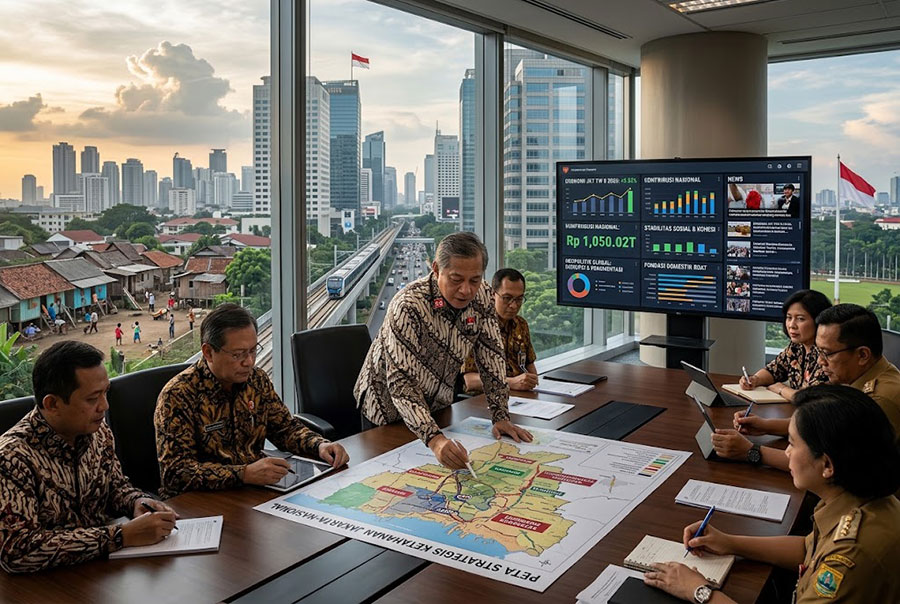
One measure of this success can be seen in Jakarta’s ability to maintain its economic foundations. In the second quarter of 2026, Jakarta’s economy recorded growth of 5.52 percent and contributed approximately Rp1,050.02 trillion to the national economy. These figures are more than mere development statistics. Behind them lies the activity of millions of people, businesses, trade, financial services, creative industries, technology, and economic networks connecting Jakarta with various regions across Indonesia and the world.
Jakarta, therefore, must not become a showcase of progress that conceals inequality behind its skyscrapers. Regional leadership must have the courage to view development from a human-centered perspective. Inclusive diplomacy that embraces diverse social groups, including religious leaders and civil society organizations, is an important part of maintaining social cohesion.
It is here that Jakarta’s development can be placed within the broader idea of fulfilling the promise of Indonesia’s independence. The nation’s founders did not struggle for independence merely so that Indonesia could replace one ruler with another. They fought so that the nation would have the ability to determine its own future. Developing Jakarta, therefore, means strengthening one of the instruments of national self-reliance.
Jakarta must become a meeting point for capital, technology, knowledge, culture, and innovation without losing its national identity. This is also where the concept of development must be freed from the trap of focusing solely on physical development. Infrastructure is important, but people are far more important. Modern transportation means little if low-income citizens are increasingly excluded from mobility. Foreign investment does not automatically constitute progress if it fails to create added value for the national economy. Digitalization cannot be considered progress if it widens inequality.
A geopolitical perspective makes these issues even more significant. Jakarta is one of the faces of Indonesia when investors, diplomats, business leaders, academics, tourists, and the international community interact with the country. Jakarta’s stability will influence perceptions of Indonesia’s overall stability.
A city that is orderly, safe, productive, inclusive, and governed credibly will strengthen international confidence. Conversely, escalating social conflict, policy uncertainty, structural congestion, extreme inequality, or crises in public services can signal weaknesses within the state.
Thus, the Governor of Jakarta occupies a strategically important position within the architecture of national resilience. The governor may not be a decision-maker in foreign policy, but the policies implemented in Jakarta can strengthen or weaken the domestic foundations that support Indonesia’s foreign policy.
Pramono Anung’s leadership should therefore be assessed not only by the number of regional government programs completed, but also by his ability to develop Jakarta as a strategic space for Indonesia’s resilience. Tactical leadership must be grounded in a long-term vision; pragmatism must remain guided by a moral compass; and urban modernization must advance alongside social justice.
Independence, therefore, finds one of its concrete expressions on the streets of Jakarta, in MRT stations, economic centers, residential neighborhoods, public spaces, schools, markets, and government offices. To be independent means that people have the opportunity to live with dignity; the state has the capacity to determine its own policies; and the city has the ability to protect its citizens from the shocks and disruptions of a changing era.
Developing Jakarta, therefore, is not merely about building a megacity. It is part of the broader effort to fulfill the promise of independence. If Jakarta can become a city that is economically strong, socially resilient, technologically advanced, equitable in its development, and firmly rooted in the values of Pancasila, then Jakarta will not only become a source of pride for Indonesia. It can also become one of the anchors that helps safeguard Indonesia’s sovereignty amid the increasingly uncertain currents of global geopolitics.
It is in this context that the leadership of Pramono Anung, a cadre of the Indonesian Democratic Party of Struggle (PDI Perjuangan), sends an important message to other regional leaders: governing a city with vision and awareness is, in essence, an integral part of strengthening a nation’s national resilience, in pursuit of a greater Indonesia.
Prof. Dr. Drs. Ermaya Suradinata, SH, MH, MS, is an observer and scholar of geopolitics, geostrategy, and government management. He is also a 2002 alumnus of the U.S. FACOM (now the U.S. Indo-Pacific Command).
 English
  Indonesian