
Indonesia Earned Global Respect After Independence as a Founder of the Bandung Conference
Indonesia’s independence on August 17, 1945, marked its political liberation from colonialism. Yet independence does not automatically command respect. A nation may be legally independent, have its own flag, its own government, and internationally recognized territory, but still remain a spectator on the world stage if it lacks the ideas, courage, and capacity to determine the course of its own history.
For this reason, the meaning of Indonesia’s independence does not end with the Proclamation of Independence. Independence must be demonstrated through the nation’s ability to safeguard its sovereignty, uphold justice, create prosperity, and, at the same time, establish Indonesia’s dignity amid the changing global order.
It is within this context that the commemoration of the 81st Anniversary of the Independence of the Republic of Indonesia on Monday, August 17, 2026, becomes an important moment to ask once again: has the independence bequeathed by the nation’s founders truly made Indonesia a sovereign, just, and prosperous nation?
The national theme, “Sovereign, Just, and Prosperous Indonesia,” accompanying the culmination of the anniversary celebrations through the state ceremony at the Merdeka Palace in Jakarta, is more than a ceremonial slogan. It also serves as a measure of how far the aspirations of independence have been realized, both in the life of the nation and in Indonesia’s position in the world.
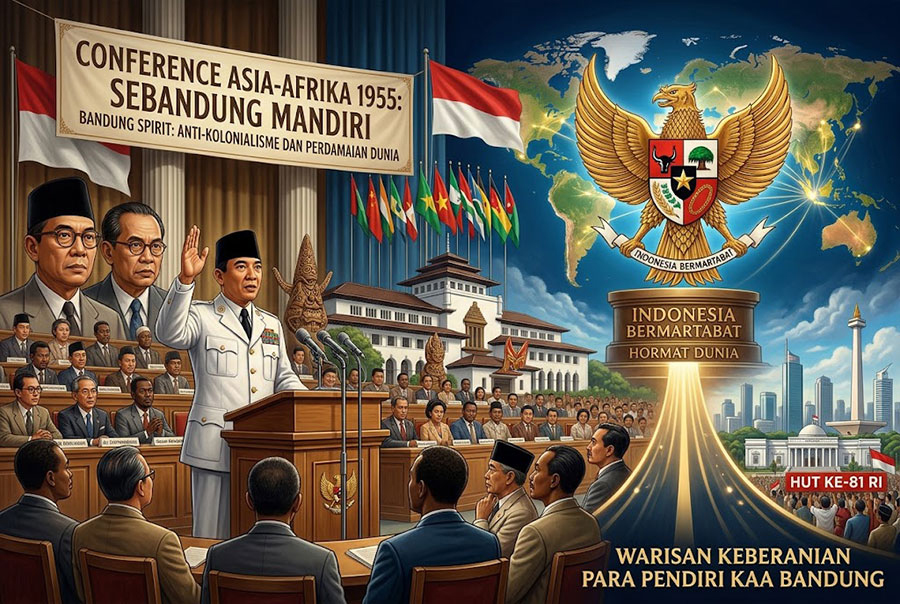
Ten years after the Proclamation of Independence, Indonesia provided an important answer to the question of national dignity through the Asian-African Conference in Bandung, held from April 18 to 24, 1955. At a time when the world was divided by the Cold War, Indonesia emerged not as a newly independent country seeking sympathy or merely searching for a place in international affairs.
Instead, Indonesia created a platform for the nations of Asia and Africa to speak in their own voices. Bandung became a defining moment when nations that had endured centuries of colonialism affirmed that independence was not a gift bestowed by great powers, but an inherent right of every nation to determine its own destiny.
For this reason, the Asian-African Conference cannot be understood merely as a diplomatic achievement for Indonesia. It was a political and moral declaration that newly independent nations had an equal right to participate in shaping the future of the world. Amid the rivalry between the two major blocs, Indonesia demonstrated that the world did not always have to be shaped by those with the most weapons, the largest economies, or the greatest political influence.
The Bandung Conference also demonstrated that a nation’s dignity is built upon the courage to put forward ideas. The founders of the Conference had a keen understanding of their time. Prime Minister Ali Sastroamidjojo proposed the idea of an Asian-African conference at the 1954 Colombo Conference, after which the proposal was further developed at the Bogor Conference. President Sukarno provided powerful political momentum and a strong anti-colonial vision, while Roeslan Abdulgani and Indonesia’s diplomats worked to transform this ambitious idea into a concrete international forum.
They were not merely organizing a conference. They were confronting a far more fundamental question: should nations that had only recently emerged from colonialism simply accept a world shaped by the great powers, or did they have the right to help shape a new world order? Bandung provided an unequivocal answer: nations that had once been colonized must not remain objects of history forever.
It was from this point that Indonesia’s independence acquired a deeper meaning. To be independent was not simply to be formally free from colonial rule, but to possess the ability to stand as an equal among other nations without sacrificing national identity or interests. Indonesia chose not to surrender its political independence to either of the great powers competing during the Cold War.
The moral force of Bandung later took more concrete form through the Ten Principles of Bandung. The principles of respect for sovereignty and territorial integrity, equality among nations, the right to self-determination, the rejection of aggression, and the peaceful settlement of disputes demonstrated that Indonesia did not enter the world stage merely to seek recognition. Indonesia came with values and principles to offer.
Indonesia’s international standing at that time, therefore, was not built solely on President Sukarno standing before the leaders of Asia and Africa. It was built on Indonesia’s ability to transform its colonial experience into universal ideas of justice and peace. Indonesia understood that a nation that had once been colonized must never repeat the practices of colonialism in any form. Independence must serve as the foundation for respecting the independence of other nations.
Today, eight decades after the Proclamation, the more important questions are directed at the present generation. Does the spirit of Bandung still live in the way Indonesia exercises its independence? Has sovereignty become a reality in the management of natural resources, the economy, technology, food, energy, maritime territory, and other areas of national strategic importance? Is justice experienced equally throughout society, or do disparities remain, allowing some citizens to enjoy the benefits of progress while others are left behind?
These questions matter because independence must not become a form of historical romanticism celebrated only every August. The raising of the Red and White flag must remind us that the work of independence remains unfinished as long as inequality, dependency, weak competitiveness, and vulnerability to external pressures persist.
In a world once again marked by great-power rivalry, trade wars, geopolitical conflicts, technological competition, struggles over resources, and shifts in global supply chains, the Bandung spirit has become even more relevant. Indonesia must not once again become merely an object that follows the course determined by major powers. In the 21st century, sovereignty can no longer be understood solely as the ability to defend national territory physically.
Indonesia’s dignity emerges when independence is translated into the courage to think and act as a sovereign nation. Therefore, the commemoration of the 81st Anniversary of the Republic of Indonesia on August 17, 2026, should not end with the state ceremony at the Merdeka Palace, the raising of the national flag, and other national celebrations.
This moment must become an occasion for national reflection on whether we still possess the moral courage demonstrated by the founders of the Bandung Conference. A nation that inherits independence without inheriting the courage of its founders risks losing the very meaning of that independence. The challenge for today’s generation is to ensure that Indonesia’s dignity does not become a relic of history, but continues to live through our efforts to realize an Indonesia Raya that is truly sovereign, economically resilient and self-reliant, and prosperous through social justice.
Prof. Dr. Drs. Ermaya Suradinata, SH, MH, MS, is an observer and scholar of geopolitics, geostrategy, and government management. He is also a 2002 alumnus of the U.S. FACOM (now the U.S. Indo-Pacific Command).
 English
  Indonesian