Corruption May Continue to Haunt Indonesia Until 2045
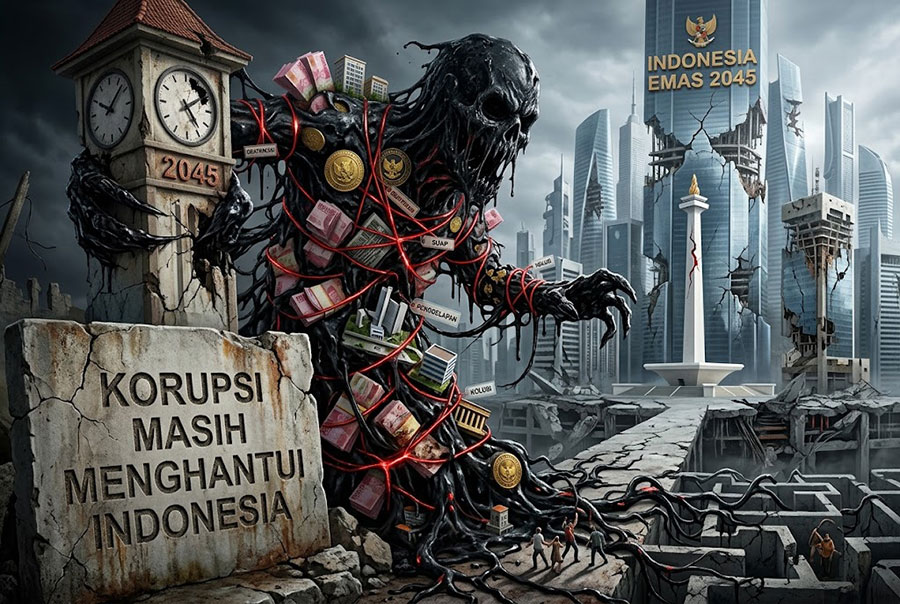
Corruption is not merely a matter of someone illegally taking state funds. It is a symptom of a deeper deterioration of values. It thrives when public office is viewed as an opportunity for personal enrichment, when power is regarded as an entitlement to be served, and when public trust is treated as a political commodity.
As long as such a mentality persists, corruption will remain a serious threat, even as Indonesia approaches 2045, when the nation aspires to become a developed country as it marks a century of independence. One of the root causes of this problem lies in the quality of human resources. Indonesia has a large population, but a large population does not automatically translate into high-quality human capital.
Therefore, power should serve as an instrument of public service, not as a means of securing personal, family, group, or political gain. If someone pursues public office primarily for status, privileges, and access to resources, corruption will always find a way in. The true measure of a public official’s success is not how high a position they hold, but how much benefit they bring to the people.
At the same time, strengthening religious understanding, the ideology of Pancasila, and a sense of national identity must remain an integral part of Indonesia’s human development. Religious understanding should not stop at rituals, but should be translated into honesty, trustworthiness, justice, responsibility, and respect for others. Likewise, Pancasila must not be reduced to memorizing its five principles in classrooms or reciting them at state ceremonies.
Pancasila must serve as an ethical foundation for social, political, economic, legal, and governmental life. A public official who truly understands the principle of Belief in the One and Only God should recognize that power is not a personal possession. Those who understand the principle of a Just and Civilized Humanity would not readily sacrifice the interests of the people for personal gain. The principle of the Unity of Indonesia requires a willingness to place the nation’s interests above those of any particular group.
We must also have the courage to reassess how we view the law. The law must indeed be enforced firmly, but law enforcement must never be separated from morality and ethics. A legal system devoid of morality can become nothing more than a set of procedures. People may fear the law, but that does not necessarily mean they respect it. By contrast, a society with strong moral awareness obeys the law not merely out of fear of punishment, but because it understands that the law is necessary to uphold justice and maintain social order.
There is an even more fundamental problem, particularly when truth no longer serves as a guiding light in life. In the public sphere, truth is often overshadowed by vested interests, popularity, power, and even deliberately manipulated information. In politics, something that is true can be distorted and portrayed as false when it does not serve the interests of a particular group. In social life, dishonesty may come to be regarded as acceptable as long as it produces benefits.
If such conditions are allowed to persist, the nation will lose its moral compass. Corruption will then cease to be regarded as an extraordinary crime and instead become something considered negotiable. This is the greatest danger: not merely the loss of state funds, but the loss of any sense of shame over wrongdoing.
Indonesia, however, must not lose its optimism. The year 2045 should be seen not merely as a statistical target for becoming a high-income country, but as a defining moment for building a greater Indonesia that is sovereign, advanced, just, and dignified. The opportunity remains wide open. Indonesia possesses a demographic dividend, strategic natural resources, a highly significant geopolitical position, a large domestic market, and extraordinary cultural wealth. All these assets can become powerful sources of national strength if they are managed by people who possess both competence and integrity.
Therefore, the path toward an advanced Indonesia must begin with human development. The national education system needs to strengthen religious values, character, national identity, skills, science, and technology in a balanced manner. The spirit of the Mental Revolution must be revitalized in a more substantive sense: developing people who are honest, disciplined, responsible, independent, hardworking, respectful of the law, and devoted to their country.
Democracy must also be strengthened through political sovereignty rooted in Pancasila. Democracy must not become merely a competition for power. It must serve as a mechanism to ensure that power works for the people. Elections, political parties, parliament, government, and state institutions must all operate within the framework of the national interest. Money politics, transactional appointments, and abuses of power must be confronted not only through law enforcement, but also through a transformation of political culture.
State officials must once again understand that public office is a sacred trust and responsibility. The trust of the people must never be treated as an opportunity for personal gain. Religious devotion, morality, and service to the nation should guide the lives of those entrusted with governing the country. Power exercised with an awareness that it is a public trust will give rise to genuine public service.
Indonesia 2045, therefore, is not merely a question of whether we are capable of becoming a developed nation. The more fundamental question is what kind of Indonesian people will lead the nation toward that progress. We may possess abundant natural resources, advanced technology, a strong economy, and modern infrastructure. Yet without morality, ethics, truth, competence, and a strong sense of national identity, all of these can become sources of conflict and corruption.
A greater Indonesia needs people who view natural wealth not as personal property, public office not as a source of privileges, power not as an entitlement, and the law not as a system whose loopholes can be exploited. Indonesia needs a generation that understands that progress must go hand in hand with justice, and that freedom must always be accompanied by responsibility.
If morality and ethics become guiding principles in national life, if education builds both character and competence, if democracy remains rooted in Pancasila, and if leaders place public trust above personal interests, then the shadow of corruption need not become Indonesia’s destiny through 2045.
With optimism, hard work, and the courage to carry out comprehensive reforms from the roots to the highest levels of governance, the centenary of Indonesia’s independence can become a historic moment marking the emergence of a greater Indonesia that is advanced, sovereign, just, prosperous, and dignified.
Ermaya Suradinata is an observer of geopolitics and geostrategy. He served as Director General of Social and Political Affairs at the Ministry of Home Affairs (1998–2001) and Governor of the National Resilience Institute of the Republic of Indonesia (LEMHANNAS RI) (2001–2005).
 English
  Indonesian