
Indonesia’s Geopolitical Stance Remains Consistently Non-Aligned, with Asta Cita Paving the Way Toward Indonesia Raya
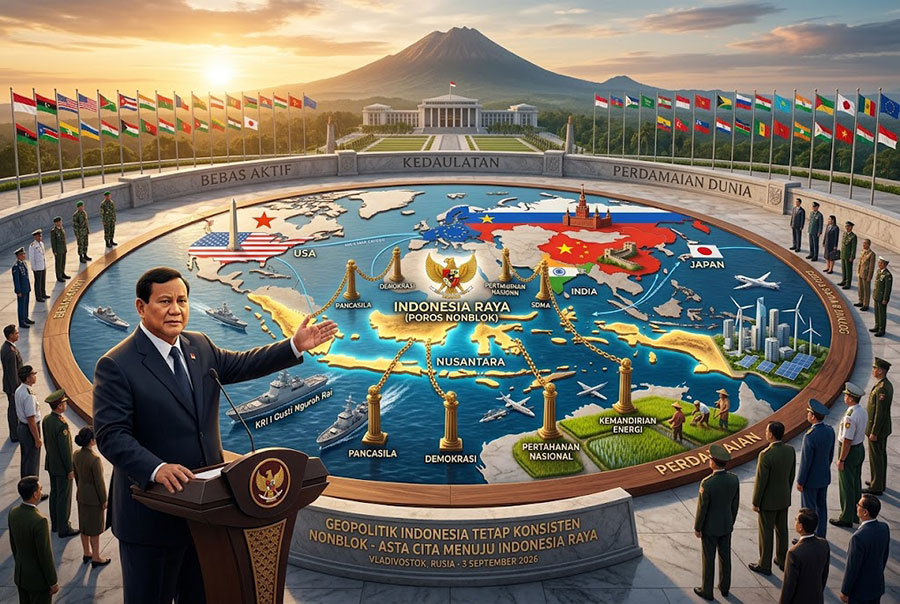
President Prabowo Subianto’s statement in Vladivostok, Russia, on September 3, 2026, reaffirmed a fundamental principle of Indonesia’s foreign policy: remaining non-aligned, refraining from joining any military alliance, while remaining open to building relations and cooperation with all countries. The statement was delivered as the President attended the 11th Eastern Economic Forum as its principal guest of honor.
In a global landscape increasingly shaped by competition among major powers, this statement was more than a diplomatic message. It reaffirmed Indonesia’s determination to remain an active subject in global affairs, rather than becoming an object that merely follows the will of other powers. This choice has deep historical roots. Since the 1955 Asian-African Conference and the establishment of the Non-Aligned Movement, Indonesia has placed independence and sovereignty at the heart of its international posture.
Indonesia’s independent and active foreign policy does not mean distancing itself from the world, nor does it imply passivity. “Independent” means that Indonesia does not align itself with any particular power bloc, while “active” means that Indonesia actively contributes to the pursuit of peace, international justice, and the protection of its national interests. In this sense, non-alignment is not merely a diplomatic position, but a manifestation of the mandate of independence.
Today’s world once again presents Indonesia with complex challenges. Competition between the United States and China continues to intensify, Russia retains significant strategic influence, while India, Japan, the European Union, Australia, and various regional powers continue to expand their interests. The international order is moving toward multipolarity, yet multipolarity does not automatically make the world more peaceful. Therefore, Indonesia’s decision not to join any particular military alliance provides the country with greater strategic room for maneuver.
Indonesia can build relations with the United States without becoming hostile toward Russia. It can strengthen economic cooperation with China without distancing itself from Japan, India, or Europe. Defense cooperation with one country should not necessarily be interpreted as alignment with a particular bloc. Indonesian diplomacy must be capable of separating national interests from geopolitical pressures so that every international relationship remains firmly within the framework of national sovereignty.
This is where Asta Cita acquires its strategic relevance. Asta Cita should not be viewed merely as a domestic development agenda, but also as a foundation for Indonesia’s geopolitical strength. An independent and active foreign policy requires a nation that is strong from within. The first Asta Cita places the strengthening of Pancasila ideology, democracy, and human rights among the foundations of governance. This is essential because Indonesia’s foreign policy must never lose its national identity.
Pancasila serves as the compass that distinguishes Indonesia’s independent and active foreign policy from a mere balance-of-power strategy. Indonesia can befriend any country, but it must never lose sight of its principles. Diplomacy must reflect the values of a just and civilized humanity, Indonesian unity, deliberative democracy, and social justice.
Asta Cita also calls for strengthening national defense and security. A non-aligned policy will lose its bargaining power if it is not supported by the ability to defend national sovereignty.
Indonesia does not need to build military strength to threaten other countries, but it must possess sufficient capabilities to ensure that no one underestimates its national interests. An independent defense capability serves as a pillar supporting Indonesia’s independent and active diplomacy.
The same principle applies to the economy. Self-reliance does not mean closing the door to foreign investment. Indonesia continues to need global investment, trade, and technology. However, such openness must be placed within the framework of national interests. Investment must generate added value, create employment, strengthen domestic industries, and enhance technological capabilities.
Food and energy self-sufficiency are also integral components of geopolitical strategy. In a world increasingly vulnerable to conflict and supply chain disruptions, food and energy are more than economic concerns. They are instruments of sovereignty. A country unable to guarantee the basic needs of its people will be more vulnerable to external pressure. Therefore, the development of agriculture, fisheries, renewable energy, infrastructure, processing industries, and national distribution networks must be positioned as part of national resilience.
Asta Cita must also be translated into an agenda for expanding Indonesia’s capacity to create, develop, and master strategic technologies. International cooperation must result in knowledge transfer and stronger national capabilities, rather than permanent dependence. This principle constitutes an important foundation for Indonesia’s diplomatic strength.
For this reason, Indonesia’s independent and active diplomacy must evolve from reactive diplomacy toward strategic diplomacy. Indonesia does not need to become involved in every geopolitical confrontation. Not every conflict should compel Indonesia to choose a side. At the same time, Indonesia must not remain silent when peace, international law, and global justice are under threat. The independent and active principle provides Indonesia with the space to serve as a bridge for dialogue when other nations become trapped in confrontation and tension.
Asta Cita also has an important governance dimension. An independent and active foreign policy requires a government that is clean, authoritative, and supported by strong legitimacy. Corruption, conflicts of interest, weak governance, and social inequality can erode Indonesia’s bargaining power from within. A country may possess vast territory and abundant natural resources, but if its institutions are weak, those strengths can easily become vulnerabilities.
Indonesia also needs high-quality human resources. A demographic dividend does not automatically translate into a geopolitical dividend. Indonesia Raya cannot be built solely through buildings, roads, and industrial estates, but also through people equipped with knowledge, character, creativity, and a strong sense of national identity. In this context, Asta Cita serves as a bridge between human development and national strength. Indonesia Raya cannot be built merely on pride in the nation’s history, but through the capacity to determine its own future.
With Pancasila as its compass, national interests as its orientation, and global cooperation as an arena for advancing those interests, Indonesia can stand firmly amid a changing world: not as a satellite of any major power, but as a nation capable of expanding its friendships, safeguarding its sovereignty, and helping shape the direction of the global order toward peace, justice, and prosperity.
This is the path toward Indonesia Raya: independent in determining its position, active in building peace, self-reliant in strengthening national capabilities, and open to friendship with the entire world.
Ermaya Suradinata
Geopolitical and Geostrategic Observer
Director General for Social and Political Affairs, Ministry of Home Affairs (1998–2001)
Governor of the National Resilience Institute of the Republic of Indonesia (LEMHANNAS RI) (2001–2005)
 English
  Indonesian