Prof. Dr. (H.C.) Megawati Soekarnoputri’s Perspectives on Bringing Pancasila to Life on the Global Stage
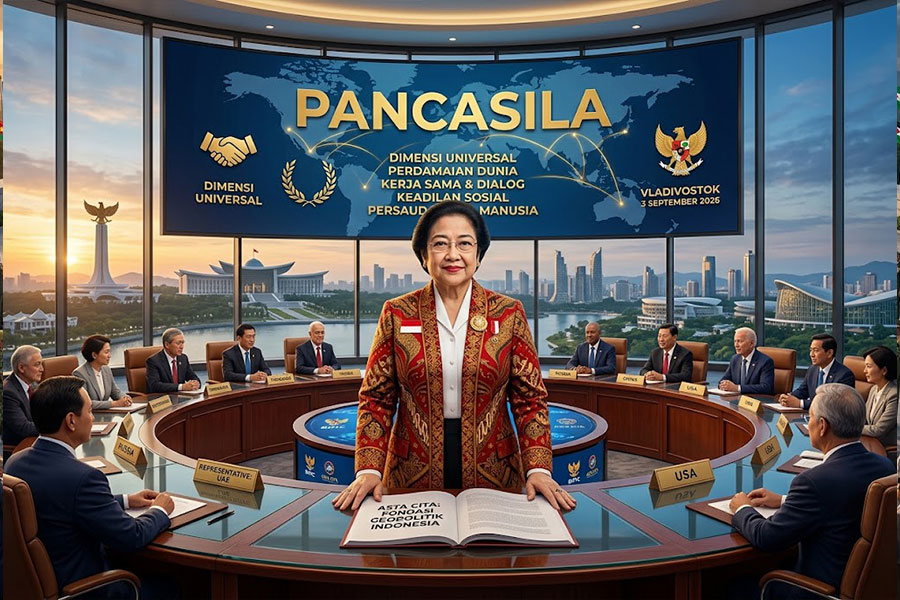
Prof. Dr. (H.C.) Megawati Soekarnoputri, Chairperson of the Steering Committee of the Pancasila Ideology Development Agency (BPIP) and the fifth President of the Republic of Indonesia, believes that Pancasila is fundamentally more than merely the foundation of the state, the nation’s ideology, and Indonesia’s philosophy of life. It also embodies values with universal dimensions. Belief in God, Humanity, Unity, Deliberation, and Social Justice are values rooted in the historical experiences of the Indonesian people, yet their essence can contribute to the broader discourse of global civilization.
These ideas have found expression through various international forums she has attended, spanning China, South Korea, and Russia to Uzbekistan and the United Arab Emirates. At these forums, Pancasila has been introduced not merely as a national identity but also as a framework connected to the pursuit of peace, equality among nations, cultural dialogue, and human fraternity.
One significant milestone took place at Fujian Normal University in Fuzhou, China, on November 5, 2018, when Prof. Dr. (H.C.) Megawati Soekarnoputri received an honorary doctorate in economic diplomacy. In her address, she highlighted the relationship between Bung Karno’s ideas, economic diplomacy, and world peace. In her view, economic relations between countries cannot be separated from the political principles that underpin them.
The experience of the 1955 Asian-African Conference serves as a historical reference demonstrating that economic cooperation and diplomacy can be directed toward reducing injustice, promoting equality, and fostering broader relations among nations. This perspective places Pancasila within the global development discourse, where progress is measured not solely by economic growth but also by its benefits to human life.
Two days later, following her visit to China, Prof. Dr. (H.C.) Megawati Soekarnoputri participated in The KOR-ASIA Forum 2018 in Seoul, South Korea, where she connected Indonesia’s historical experiences with efforts to pursue a peaceful solution for the Korean Peninsula. She recalled Bung Karno’s meeting with the North Korean leader in 1965 and placed that historical encounter within the context of the importance of dialogue amid political disagreements. Here, Pancasila takes on practical significance: differences do not have to lead to hostility, while conflict resolution requires a willingness to communicate and respect others.
Similar ideas resurfaced at The 8th World Peace Forum in Beijing in July 2019. At the forum, which addressed shared responsibility, shared governance, and shared benefits, Prof. Dr. (H.C.) Megawati Soekarnoputri emphasized the importance of respecting the sovereignty of every nation. This perspective aligns with the spirit of “To Build the World Anew,” a vision once presented by Bung Karno at the United Nations.
From the perspective of Pancasila, solidarity is not merely a moral expression but a principle that must be realized through collective action. Gotong royong, the spirit of mutual cooperation deeply rooted in Indonesian social life, can serve as an inspiration for strengthening international cooperation without compromising the sovereignty of individual nations.
Efforts to bring Pancasila’s values into everyday practice have also been pursued through cultural diplomacy. During the An Exotic Journey to Nusantara event in Seoul in 2021, Indonesia’s rich cultural heritage was presented as an expression of national identity and a means of fostering cross-cultural understanding. This approach is important because international relations do not always have to begin with political negotiations or economic interests. Arts, traditional textiles, customs, languages, and cultural heritage can create opportunities for more meaningful human connections. In this context, Bhinneka Tunggal Ika (Unity in Diversity) conveys the lesson that unity does not require the elimination of differences.
In September 2024, Prof. Dr. (H.C.) Megawati Soekarnoputri brought the ideas of Pancasila to Russia through a public lecture at St. Petersburg State University. She connected the principle of Humanity with the aspiration to build global fraternity, while Social Justice was associated with the struggle to establish a peaceful and equitable international order.
Thus, Pancasila addresses not only the relationship between a state and its citizens but also Indonesia’s responsibilities within the international community. In a world marked by geopolitical rivalries, this perspective serves as a reminder that the strength of one nation should never be used as justification for undermining the sovereignty of another.
Later that same month, her visit to Uzbekistan expanded this approach through education and culture. The conferment of an honorary professorship by Silk Road International University of Tourism and Cultural Heritage in Samarkand demonstrated the existence of an academic platform for connecting Indonesia’s national experiences with dialogue among civilizations. Pancasila can contribute to such dialogue without being presented as an ideology that other nations must adopt.
The humanitarian dimension of Pancasila became evident once again when Prof. Dr. (H.C.) Megawati Soekarnoputri attended a human fraternity forum in Abu Dhabi, United Arab Emirates, in February 2026. At this forum, she presented Pancasila as a framework of values capable of supporting human fraternity and peaceful coexistence. This perspective positions humanity as common ground amid differences in religion, culture, and worldviews.
Pancasila does not seek to replace the beliefs or traditions of other nations. Instead, it offers Indonesia’s experience in building a shared life within a diverse society. Human fraternity becomes particularly important when differences are frequently used to create divisions and intensify conflicts. Pancasila will gain greater significance in the eyes of the world when the international community can witness its practical application in everyday life.
Therefore, Megawati’s vision of translating Pancasila’s values into concrete action must be developed into sustained collective efforts. BPIP, the Ministry of Foreign Affairs, universities, research institutions, cultural communities, and younger generations can strengthen Pancasila diplomacy through education, research, academic exchanges, peace dialogues, and humanitarian cooperation. Its success should not be measured merely by the number of forums attended or speeches delivered, but by the extent to which these ideas generate understanding, cooperation, and tangible benefits for the global community.
Ultimately, bringing Pancasila’s values to life on the global stage is not an attempt to position Indonesia as a teacher to other nations. Rather, it is an effort to offer Indonesia’s experiences as a source of mutual learning. Pancasila is deeply rooted in the history and culture of the Indonesian archipelago, yet the values of humanity, deliberation, unity, and justice that it embodies can open pathways for universal dialogue.
Prof. Dr. Drs. Ermaya Suradinata, S.H., M.H., M.S. Geopolitical and Geostrategic Observer Director General of Social and Political Affairs, Ministry of Home Affairs of the Republic of Indonesia (1998–2001) Governor of the National Resilience Institute of the Republic of Indonesia (LEMHANNAS RI) (2001–2005)
 English
 Indonesian