
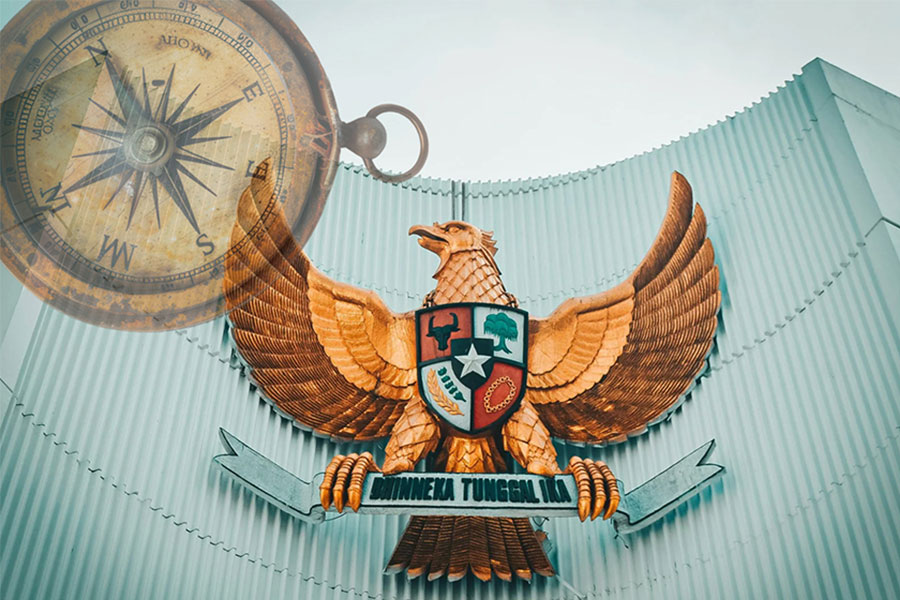
Pancasila as the Nation’s Compass: BPIP as a Historical Necessity

Amid a world moving at great speed—marked by technological disruption, a crisis of values, and global ideological contestation—the Indonesian nation is, in fact, not lacking guidance. Pancasila has long stood as both the foundation and the ethical horizon of national and state life.
Nevertheless, the fundamental issue does not lie in the presence or absence of Pancasila, but in how seriously the state manages it as a living ideology. It is within this context that the role of the Pancasila Ideology Development Agency (BPIP) and the urgent need for a strong legislative framework become increasingly relevant.
Pancasila is not merely the constitutional foundation of the state in a juridical–formal sense. It is the nation’s philosophy, encompassing views on humanity, society, power, law, and the shared purpose of life. As a philosophy, Pancasila provides a comprehensive and integrative framework of thought. It answers the most fundamental questions: why the state is established, how power should be exercised, and which values should serve as benchmarks for the success of development.
Without this philosophical understanding, Pancasila is easily reduced to a symbol, a political slogan, or merely a ceremonial ornament. Therefore, the philosophy of Pancasila functions as the moral and intellectual compass of national development, ensuring that progress does not lose its direction or become detached from human values.
Amid the temptations of economic pragmatism and policy technocracy, Pancasila reminds us that genuine development is not only about growth, but also about justice, civility, and unity. A state that develops without a guiding philosophy is prone to slipping into a logic of mere efficiency, neglecting those left behind and marginalizing weaker voices.
It is here that BPIP finds its strategic role. BPIP is not merely an administrative body, but an ideological institution of the state. It serves as a space for reflection, study, and the grounding of Pancasila so that it remains relevant in changing times. Without strong institutional and legal foundations, ideological development risks becoming sectoral, sporadic, and dependent on short-term political will. A BPIP Law is therefore necessary to ensure the continuity, independence, and authority of this institution in carrying out the state’s ideological mandate.
At the same time, the philosophy of Pancasila must function as a critical instrument for evaluating legal products and public policies. Law is never value-neutral. Every statute, regulation, and judicial decision reflects particular views on justice, humanity, and the public interest. Without the value framework of Pancasila, law may drift away from society’s sense of justice and even legitimize inequality and structural injustice.
With a clear legal foundation, BPIP can play a role in providing ideological and ethical perspectives on the direction of national lawmaking, including assessing whether legal products are aligned with Pancasila’s values. In the judicial context, the philosophy of Pancasila is equally vital as the spirit of substantive justice. Decisions of the Constitutional Court, the Supreme Court, and other judicial bodies must not only be procedurally valid, but also morally and socially just.
In the broader project of building Indonesia Raya, the philosophy of Pancasila serves as a grand compass, ensuring that development does not lose its humanistic spirit and commitment to social justice. Indonesia Raya is not merely about infrastructure advancement or economic growth, but about realizing a sovereign, just, and dignified nation. A BPIP Law is essential to ensure that all processes of development, lawmaking, and the exercise of power remain firmly rooted in Pancasila’s values.
With a strong legal foundation, BPIP can carry out its role as the guardian of the state’s ideological orientation, ensuring that development does not deviate from constitutional ideals and the public’s sense of justice. BPIP is not merely an institution; it is a state instrument for nurturing the nation’s ideological consciousness. Pancasila must be continuously reflected upon, lived out, and realized in policies, laws, and the ethical conduct of national life.
With solid legislative support, BPIP ensures that Pancasila remains the soul and body of Indonesia Raya’s development—not merely a cherished historical legacy, but a living force that guides the Indonesian nation confidently, with civility, and with fidelity to its identity. Without serious ideological stewardship, these ideals are easily distorted by short-term political interests.
Through education and ideological development, BPIP functions to safeguard the continuity of national vision across generations, ensuring that changes in power do not mean changes in the state’s fundamental values. In an increasingly complex social landscape, the philosophy of Pancasila also serves as an instrument for managing diversity. Indonesia is not a homogeneous state, but a fragile yet rich social mosaic.
Without a consciously managed unifying ideology, diversity can become a source of conflict. BPIP is present to cultivate Pancasila as a meeting point—not as a tool of uniformity, but as a space for fair and inclusive dialogue. Equally important, BPIP plays a role in overseeing the character, ethics, and moral foundations of national life. Public ethical crises, corruption, and abuses of power are, at their core, crises of values.
Thus, the need for a BPIP Law is essentially the need for the state’s seriousness in safeguarding its identity amid rapid change and intense value contestation. Pancasila is not merely a declarative state foundation, but a living philosophy of the nation that articulates views on humanity, power, justice, and the purpose of statehood.
In a world dominated by global ideologies, economic pragmatism, and short-term political interests, Pancasila cannot be left to stand alone. It requires conscious, systematic, and sustained management to remain relevant and capable of guiding national development.
Prof. Dr. Ermaya Suradinata, SH, MH, MS
Rector of IPDN (2015–2018); Former Director General of Socio-Political Affairs, Ministry of Home Affairs of the Republic of Indonesia (1999–2001); Former Governor of the National Resilience Institute (LEMHANNAS RI) (2001–2005)
 English
  Indonesian