Global Geopolitics Is Shifting, Indonesia Must Prioritize the Law on Grounding the Ideology of Pancasila
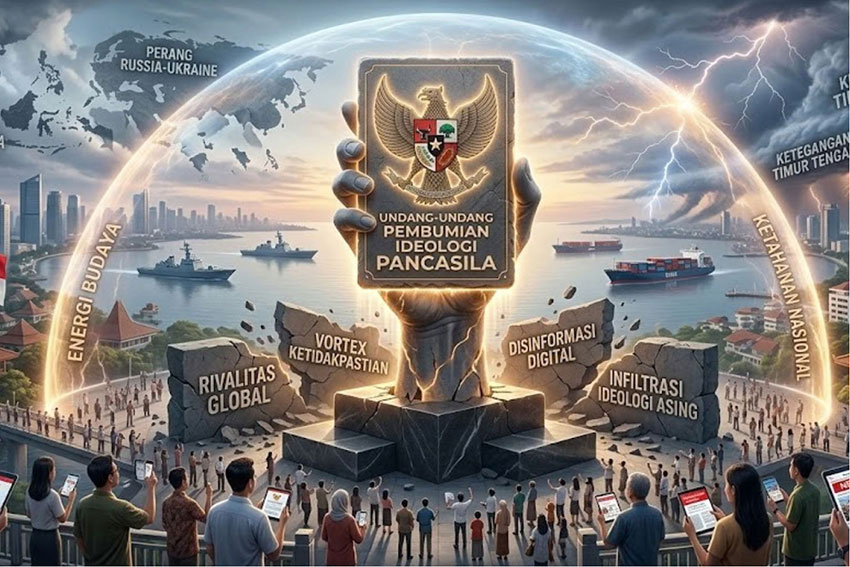
Today’s world no longer moves along a calm, linear course of history; instead, it spins within a vortex of uncertainty where power, interests, and identities converge in a complex space of conflict. The strategic rivalry between China and the United States has divided the horizon of global power into competition across technology, military strength, and normative influence.
The Russia–Ukraine war marks the return of classical geopolitics in a modern form; the Palestine–Israel conflict continues to test the moral consistency of the international order; tensions between the United States and Iran shake global energy stability; turbulence in the Middle East reveals the fragility of regional balance; while tensions between Thailand and Cambodia remind us that Southeast Asia is not entirely immune from escalation.
Within such a multilayered global landscape, threats no longer appear as isolated events but as an atmosphere that seeps into economic, social, digital, and cognitive spaces. Indonesia, standing at the crossroads of trade routes and civilizations, cannot rely solely on strengthening its physical defenses; it requires an ideological foundation capable of maintaining direction amid rapidly shifting currents.
Many nations have collapsed not because they lost wars, but because they lost a unifying national narrative. When collective identity weakens, transnational ideological infiltration, digital disinformation, and proxy conflicts find fertile ground. In this context, Pancasila gains strategic significance as a cultural energy that preserves social cohesion. However, this energy does not operate automatically; it requires an institutional framework to ensure that its values live within public policy, education, and state governance.
This is where the urgency of a Law on Grounding the Ideology of Pancasila becomes relevant as a normative instrument linking ideology with praxis. Pancasila is not merely a constitutional text; it is a moral compass that balances freedom and responsibility, diversity and unity, sovereignty and openness. Amid globalization—bringing extreme ideologies, identity populism, and exploitative economic liberalism—Pancasila functions as a normative filter that ensures change does not uproot the nation’s cultural foundations.
Without systematic legal reinforcement, however, Pancasila risks remaining a ceremonial symbol lacking transformative power. A law regulating the grounding of ideology is needed not to institutionalize doctrine, but to ensure that Pancasila’s values are internalized in public policymaking, the education system, and bureaucratic conduct.
Global geopolitics increasingly emphasizes information warfare and contests of perception, making ideology a new arena of defense. Digital disinformation can fracture societies more rapidly than armed conflict because it operates within the realm of consciousness. In such circumstances, Pancasila functions as a social vaccine that fosters trust and solidarity.
In foreign policy, Pancasila provides normative legitimacy for Indonesia’s free and active doctrine, enabling the country to maintain strategic autonomy amid great power rivalry. The principle of just and civilized humanity guides diplomacy oriented toward peace, while popular sovereignty ensures that foreign policy is not co-opted by bloc interests. This position allows Indonesia to act as a balancing bridge rather than as a satellite drawn into external currents.
A Law on Grounding the Ideology of Pancasila could strengthen the consistency between domestic values and diplomatic practice, ensuring that foreign policy is not merely pragmatic but anchored in clear ethical foundations. Yet the urgency of such a law lies not only in geopolitics but also in addressing the domestic gap between rhetoric and reality. When Pancasila is reduced to a slogan, it loses relevance in the eyes of younger generations living in a pragmatic digital environment.
Within this framework, the role of the Pancasila Ideology Development Agency becomes strategic as a laboratory of thought translating Pancasila’s values into concrete policies in digital economy development, cyber resilience, energy transition, and ecological justice. A Law on Grounding the Ideology of Pancasila could provide a stronger and more measurable mandate for this institution—not merely to socialize values, but to generate value-based policy recommendations.
From the perspective of national resilience, grounding Pancasila is closely linked to social justice. Widening economic inequality creates space for alternative ideologies offering illusory solidarity. The implementation of the principle of social justice must be reflected in redistributive policies, strengthening of the people’s economy, and sovereign management of natural resources. The law could serve as a normative foundation to ensure that development pursues not only growth but also equity.
In the digital era, the geopolitical arena shifts into the cognitive domain, where public perception is contested. Value-based digital literacy, creative production of national narratives, and strengthening a healthy information ecosystem become elements of non-physical defense. A Law on Grounding the Ideology of Pancasila could provide a systematic framework to integrate these efforts, ensuring that Pancasila remains a living ideology—capable of adapting to new mediums without losing its substance.
Thus, an increasingly uncertain global geopolitical environment demands that Indonesia be strong not only materially but also ideologically. A Law on Grounding the Ideology of Pancasila is not merely legislative output; it is a strategic statement that Indonesia chooses to preserve its identity amid powerful global currents.
It is an effort to safeguard the meaning of the nation’s existence, to ensure that change does not sever collective memory, and to guarantee that the future remains anchored in the values of humanity, justice, and unity.
Prof. Dr. Drs. Ermaya Suradinata, SH, MH, MS, is an observer of geopolitics, geostrategy, and public administration management.
 English
  Indonesian