National Education System Policy Wisdom Strategy Based on Pancasila Democracy
In a world that is moving increasingly fast, education is often forced to function like a production machine: generating numbers, pursuing rankings, and meeting labor market demands. Schools are gradually measured not by their ability to shape human beings, but by graduation statistics, literacy scores, or their capacity to produce competitive workers.
Yet education is not merely about enabling people to make a living; it is also about helping them understand the meaning of life. A great nation is built not only by intellectual excellence, but by individuals who possess conscience, moral awareness, and the ability to uphold humanity amid the challenges of changing times.
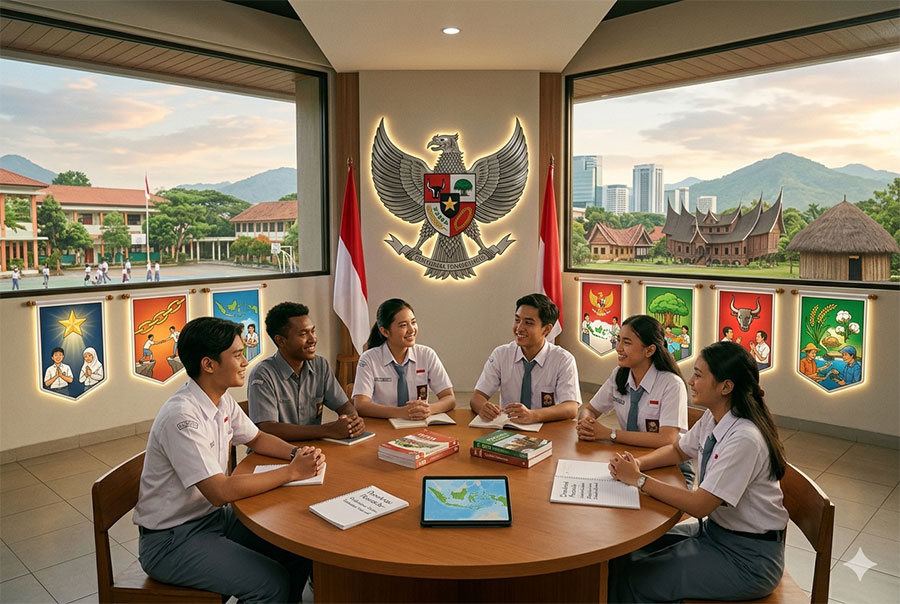
This is where Pancasila finds its deepest relevance. It is not merely the state ideology memorized in schools, but the spirit that should animate the entire orientation of Indonesian education. Pancasila Democracy does not view human beings simply as numbers in economic development, but as whole persons with spiritual, social, and national dimensions.
The First Principle, Belief in the One and Only God, reminds us that knowledge without morality can become a threat to humanity. Today, the world is entering an era of artificial intelligence, digital information overload, and technological revolutions beyond the imagination of previous generations. At the same time, however, the world is witnessing growing ethical crises, intolerance, information manipulation, and a declining sense of respect among people. Divine values are not merely religious lessons taught in classrooms; they are the awareness that knowledge must be used to uplift life, not destroy it.
Amid an increasingly individualistic global environment, the Second Principle, Just and Civilized Humanity, serves as an important reminder that education is the right of every citizen. Education must not become a luxury accessible only to those living in major cities or possessing economic privilege. Children in coastal regions, remote areas, border zones, and small islands have dreams just as great as those of children in urban centers.
Too often, however, these dreams are hindered by unequal facilities, shortages of teachers, and limited access to technology. When education fails to reach those who need it most, the nation is effectively allowing injustice to grow gradually. Educational inequality will ultimately lead to even greater social inequality.
The Third Principle also emphasizes that education has a responsibility to safeguard Indonesian unity. This nation stands upon extraordinary diversity. Indonesia is one of the most pluralistic countries in the world, consisting of 17,380 islands, 1,340 ethnic groups, 718 regional languages, and six officially recognized religions along with local belief systems. All coexist within one national home.
However, today’s digital world also presents new threats in the form of social polarization, narrow-minded fanaticism, and identity-based conflicts that spread easily through screens held in people’s hands. In such circumstances, schools should become spaces of encounter that teach tolerance and respect for differences. Education should not merely train students to memorize definitions of unity, but cultivate the practice of living together in diversity.
The Fourth Principle, concerning democracy guided by wisdom through deliberation and representation, also contains profound messages for education. For many years, education has often been built upon a one-way model: teachers speak and students listen; teachers decide and students follow. Yet healthy democracy does not emerge from a culture of silence, but from the ability to engage in dialogue and think critically.
Therefore, the Fourth Principle teaches that schools should become the earliest training grounds for democracy, where children learn to respect the opinions of others, express their ideas respectfully, and seek common ground through deliberation. Democratic education is not education that permits unrestricted freedom without direction; rather, it is education that nurtures maturity of thought and wisdom in responding to differences.
Meanwhile, the Fifth Principle, Social Justice for All Indonesians, reminds us that education must serve as a pathway for social mobility for ordinary citizens. Education must not merely produce a small elite increasingly detached from society. Instead, it should become a bridge of hope for those born into modest circumstances to achieve a better life.
For this reason, educational development cannot be entirely standardized. Indonesia has diverse social realities. Coastal regions require education that understands the maritime sector; agricultural regions require education that strengthens food production; while industrial areas require relevant technological and vocational skills. Education loses its meaning if it cannot respond to the realities and needs of the communities it serves.
Within an increasingly competitive global geopolitical landscape, education has become an arena for shaping the future of nations. Indonesia needs a generation capable of competing globally without losing its national identity. Globalization without a strong foundation of values will only produce a generation that appears modern on the surface but is fragile in its sense of identity. Law Number 20 of 2003 on the National Education System has already provided clear direction: Indonesian education must be rooted in religious values, national culture, and the demands of changing times.
Education is a long-term process of shaping the soul of a nation. If education remains grounded in the spirit of Pancasila—divinity, humanity, unity, deliberation, and social justice—Indonesia will not only produce intelligent generations but also generations capable of preserving the dignity of their nation in a constantly changing world.
Prof. Dr. Drs. Ermaya Suradinata, SH, MH, MS
Geopolitics, Geostrategy, and Public Administration Observer.
 English
  Indonesian