Current Geopolitical Changes Require the Transformation of the United Nations Organization (Part I)
The world is entering a new chapter in its geopolitical history. Competition among major powers is intensifying once again, armed conflicts continue to emerge across various regions, cyber threats are becoming increasingly difficult to contain, climate change is triggering humanitarian crises, while competition over strategic natural resources and advanced technologies has become the new face of international rivalry. As a result, the international security architecture established after the end of the Second World War is now confronting challenges far more complex than those that existed when the United Nations (UN) was founded in 1945.
The United Nations was established from humanity’s collective hope that the tragedy of global war would never be repeated. When the organization was officially founded on 24 October 1945, it consisted of only 51 member states. At that time, much of Asia and Africa remained under colonial rule and therefore lacked the opportunity to determine their own destinies. The structure of the UN Security Council was designed according to the post-World War II balance of power, granting permanent membership and veto power to five countries: the United States, the Soviet Union (later succeeded by Russia), the United Kingdom, France, and China. At that time, this arrangement was widely regarded as a realistic mechanism for preserving global stability.
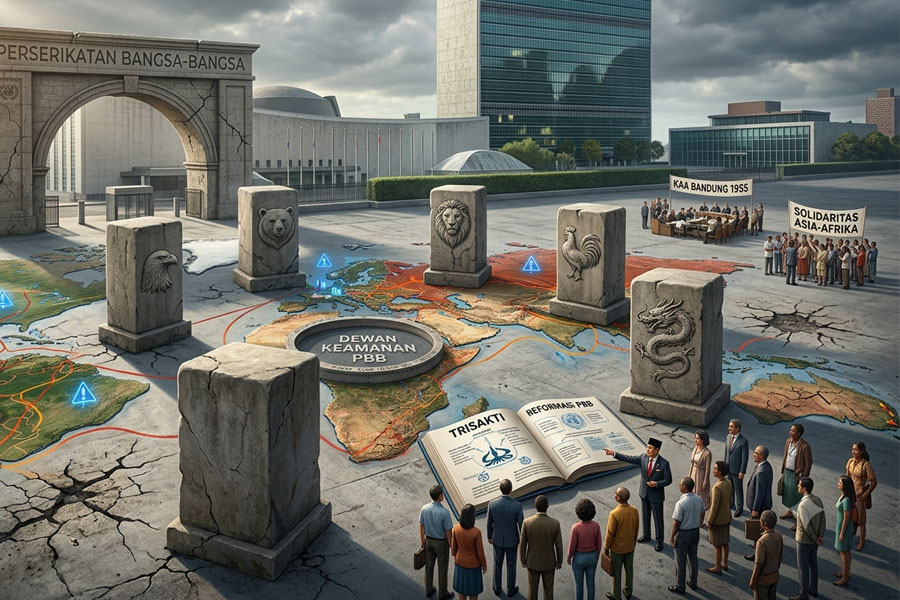
History, however, never stands still. Only a decade after the United Nations was established, the world witnessed a pivotal event that reshaped international politics through the Asian-African Conference (Bandung Conference) held in Bandung, Indonesia, in April 1955. Representatives from 29 Asian and African countries gathered not merely to strengthen solidarity, but also to deliver a moral message to the world that colonialism—in whatever form—must be eradicated. The conference represented more than half of the world’s population at the time and became a symbol of the awakening of nations that had endured centuries of colonial domination.
By the time the Bandung Conference took place, UN membership had already increased to approximately 76 countries, reflecting the growing momentum of global decolonization. The wave of independence continued throughout the 1960s and into the early twenty-first century. Today, the United Nations comprises 193 member states representing diverse political systems, economic structures, cultural backgrounds, and stages of development.
Yet despite these extraordinary global transformations, the structure of the Security Council has remained largely unchanged. The same five countries that received veto power more than eighty years ago continue to retain that privilege. Here lies one of the greatest paradoxes of global governance. While UN membership has nearly quadrupled since its establishment, the distribution of decision-making authority remains concentrated within a structure created according to the geopolitical realities of 1945.
This situation raises fundamental questions regarding the legitimacy, representation, and effectiveness of the Security Council in addressing the challenges of the twenty-first century. A world that has become increasingly multipolar requires a decision-making system that is more inclusive and better reflects the actual balance of global power. The veto power originally granted to the five permanent members was intended to prevent direct confrontation among the world’s major powers.
In practice, however, the veto has frequently become an obstacle when the international community requires swift action to halt armed conflicts, deliver humanitarian assistance, or impose sanctions for violations of international law. Numerous resolutions have failed because the political interests of major powers have taken precedence over humanitarian considerations. Consequently, the credibility of the United Nations is often questioned, particularly by developing countries that believe they have not been granted fair representation within the organization’s highest decision-making body.
Transforming the Security Council does not mean abandoning the balance of global power. Rather, it means updating that balance to reflect contemporary realities. Expanding permanent membership to include representatives from Asia, Africa, and Latin America, while also considering reforms to the veto mechanism, deserves serious consideration. The institutional structure of the United Nations should therefore reflect today’s geopolitical landscape rather than simply preserve the legacy of history.
In this context, Indonesia possesses strong historical legitimacy to advocate for such reforms. The nation was not only born from the struggle against colonialism, but also became a pioneer in fostering solidarity among developing countries through the Asian-African Conference. Indonesia’s first President, Sukarno, believed that true independence meant more than liberation from military occupation; it also required freedom from all forms of political, economic, and cultural domination.
For this reason, Sukarno’s famous declaration that “colonialism must be abolished from the face of the earth” carries a meaning far broader than the elimination of classical colonialism alone. In the evolution of modern geopolitics, colonialism itself has undergone transformation. Control over natural resources through economic dependency, domination of digital technologies, manipulation of global supply chains, financial pressure, and the exploitation of data have become the new manifestations of twenty-first-century colonialism.
The enduring relevance of Sukarno’s vision became even more evident when he delivered his historic address, “To Build the World Anew,” before the United Nations General Assembly in 1960. In that speech, Sukarno criticized an international order dominated by the interests of major powers and called for the creation of a new world order founded upon justice, equality, and respect for the independence of every nation.
These ideals were further reinforced through Sukarno’s concept of Trisakti. Trisakti teaches that Indonesia must be politically sovereign, economically self-reliant, and culturally grounded in its own identity. These three principles not only serve as the foundation for national development but also offer a paradigm for a more equitable system of international relations.
Political sovereignty affirms that every nation has the equal right to determine its own future without coercion from foreign powers. Economic self-reliance emphasizes that natural resources should be managed for the greatest possible prosperity of the people rather than becoming objects of global exploitation. Cultural identity reminds us that modernization should never come at the expense of a nation’s unique heritage and character.
If the principles of Trisakti are applied to global governance, then the transformation of the United Nations should aim to establish an international system that respects the equality of all nations, strengthens the sovereignty of developing countries, and ensures that international law is applied fairly and without discrimination. Consequently, reforming the United Nations is not merely an administrative or institutional exercise. It is part of humanity’s broader and enduring struggle to build a world order that is more just, democratic, and civilized.
Prof. Dr. Drs. Ermaya Suradinata, S.H., M.H., M.S.
Observer of Geopolitics, Geostrategy, and Government Management
 English
  Indonesian