Indonesia Needs Economic, Political, Legal, and National Resilience to Realize a Greater Indonesia
Uncertainty has become the defining feature of today’s world. As wars continue in various regions, rivalry among major powers intensifies, technological disruption accelerates without pause, and pressures on the global economy continue to mount, every nation is required to develop far greater resilience than ever before.
In such circumstances, Indonesia cannot rely solely on the size of its domestic market, its abundant natural resources, or its demographic dividend. What is even more critical is the nation’s ability to maintain economic, political, legal, and security stability as the foundation for sustainable development. Without stability, economic growth becomes fragile. Without unity, progress can easily come to a halt.
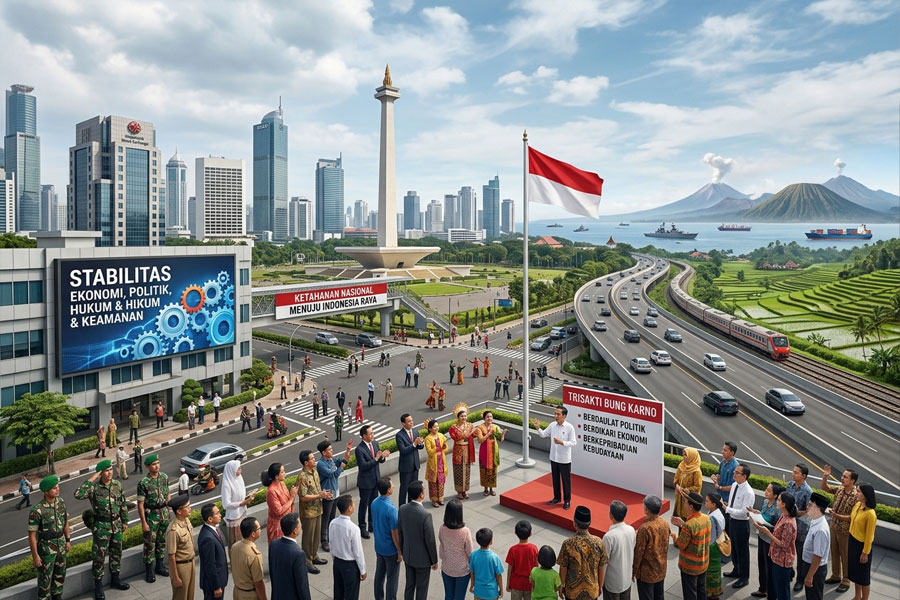
It is in this context that President Sukarno’s concept of Trisakti finds renewed relevance. The principles of political sovereignty, economic self-reliance, and cultural identity are not merely historical ideals but enduring strategic guidelines for navigating the challenges of the twenty-first century. Political sovereignty enables Indonesia to determine its own national interests amid global geopolitical competition. Economic self-reliance strengthens the country’s resilience against fluctuations in international markets, while cultural identity safeguards the nation’s character from being eroded by the forces of globalization.
Building national stability, therefore, is an essential part of realizing the vision of Trisakti in the life of the nation. Yet Trisakti can never become reality unless it is supported by a constructive national character. Indonesia needs a mindset that views every challenge as an opportunity to strengthen unity rather than deepen divisions, prioritizes solutions instead of prolonging conflict, and places national interests above sectional or short-term political interests.
Such a constructive character begins with the nation’s capacity to manage crises in an adaptive manner. Today’s world is confronted with threats that are no longer conventional. Health emergencies, geopolitical conflicts, disruptions to global supply chains, cyberattacks, and climate-related disasters can emerge simultaneously and interact with one another. Consequently, Indonesia requires an integrated, data-driven crisis management system capable of detecting risks at an early stage, supported by responsive leadership and effective coordination among government institutions.
A nation that possesses the capacity to manage crises effectively will be able to preserve national stability while maintaining the confidence of both its citizens and the business community. Successful crisis management depends upon the solidarity of every component of society. No country can overcome major challenges if its national energy is consumed by internal conflict. The executive and legislative branches, security institutions, the business sector, academia, the media, civil society organizations, religious leaders, and the public must move in harmony, placing the national interest above sectoral or temporary political considerations.
Democracy naturally provides room for differing opinions. However, such differences should become a source of strength in formulating solutions rather than a justification for deepening polarization. Amid intensifying global competition, national unity is a strategic asset whose value exceeds even the nation’s abundant natural resources.
National stability can only stand on a firm foundation when supported by clean, responsible governance and a professional state apparatus. A bureaucracy that is professional, transparent, and accountable serves as the primary engine of national development. When public officials perform their duties with integrity, competence, and a genuine commitment to public service, public trust in the state will increase. Conversely, corruption, abuse of authority, and weak accountability undermine governmental legitimacy while discouraging investment and hindering development.
National development also requires a shared understanding that the national interest must remain the primary orientation of every element of society. Such national consciousness serves as a safeguard against various threats to national unity, including ideological infiltration, the spread of disinformation, radicalism, and transnational interests that exploit digital platforms to divide society.
A nation with a strong awareness of its national interests is able to regard diversity as an asset of democracy rather than a source of hostility. Character education, the strengthening of Pancasila values, digital literacy, and civic education must therefore continue to be reinforced so that society possesses the resilience needed to resist various forms of information manipulation that could threaten political stability and national security.
This commitment to the national interest must be translated into a determination to safeguard the nation’s sovereignty in all its dimensions. Sovereignty does not merely mean defending territorial integrity against military threats. It also means ensuring that Indonesia can manage its own natural resources, strengthen food and energy security, develop competitive domestic industries, and master strategic technologies.
These collective efforts will only produce genuine national strength if they are inspired by the spirit of gotong royong, or mutual cooperation. This enduring Indonesian value teaches that even the greatest challenges are more effectively addressed through collaboration than confrontation. Within the context of national development, this spirit must be expressed through synergy among the central and regional governments, the business community, universities, local communities, the media, and society as a whole.
The spirit of gotong royong also provides the pathway for actualizing Sukarno’s vision of Trisakti. Political sovereignty means that Indonesia makes decisions based on its national interests, free from external pressure. Economic self-reliance means building an economy founded upon domestic productivity, innovation, and the sustainable utilization of national resources. Cultural identity means preserving the nation’s unique character amid the accelerating forces of globalization, ensuring that modernization does not erode the noble values that define Indonesia.
Trisakti is far more than a political slogan. It is a strategic framework for national development that integrates stability, sovereignty, and prosperity into a unified vision. Today, Indonesia requires economic, political, legal, and security stability not merely to preserve public order, but as the essential foundation for realizing a stronger and greater Indonesia (Indonesia Raya).
Prof. Dr. Drs. Ermaya Suradinata, SH, MH, MS is an Indonesian scholar and observer of geopolitics, geostrategy, and public governance. He is also an alumnus of the U.S. FACOM (now the U.S. Indo-Pacific Command), Class of 2002.
 English
  Indonesian